

Full House in Poker: Rules, Ranking, and Winning Strategies
Navigating the complexities of poker can feel daunting, especially when stumbling upon intriguing and high-ranking hands like a full house. If you’re trying to crack the strategy code or learning about various hand rankings, consider this your ticket to understanding all aspects of poker’s highly coveted full house. Discover everything from the basic rules and how it stacks up against other hands to razor-sharp strategies to increase your winning probability. So buckle up as we dive deeper into the bluffing and betting world and seek mastery over one of the most influential combinations in Poker- ‘The Full House.’
A full house is a hand that contains three cards of one rank and two cards of another rank. It ranks below four of a kind and above a flush. In Texas Hold’em, it is important to recognize the strength of your full house relative to the board and potential opponent’s hands, as overplaying it can lead to costly mistakes.
Overview of Full House in Poker

In the exciting world of poker, a full house is a hand that showcases the perfect blend of strength and variety. It’s a combination that can bring immense satisfaction and potentially lead to significant wins at the poker table. Understanding the ins and outs of a full house is essential for any poker player looking to elevate their game. So, let’s dive into an overview of a full house in poker.
A full house is a hand that consists of three cards with the same rank and a pair of cards with another rank. For example, having three Kings and two Queens would constitute a full house. The ranking of a full house is determined by the value of the three matching cards first, followed by the pair’s value. A full house ranks below four of a kind and above a flush in the hierarchy of poker hands.
When comparing two or more full houses, the strength is determined by ranking the three matching cards first. In the case of a tie, if multiple players have an identical three-of-a-kind, the strength is assessed based on the rank of the pair. For instance, three Jacks and two Aces would beat three Tens and two Kings.
Achieving a full house requires both skill and strategic decision-making during gameplay. It’s not just about luck but also understanding your opponents’ behaviors and adapting your betting strategies accordingly. Knowing when to bet aggressively or conservatively based on your hand’s strength and reading other players’ reactions can greatly impact your chances of successfully landing a full house.
With a general understanding of what constitutes a full house, let’s explore its combination’s intricacies.
Understanding Full House Combination
To truly grasp the concept of a full house, it’s important to analyze its components: three-of-a-kind and the pair. The three-of-a-kind aspect refers to having three cards of the same rank, while the pair signifies having two cards of another rank. Together, these components intertwine to form the powerful combination known as a full house.
Imagine finding yourself in a game of Texas Hold’em, holding three 8s. Then, as the community cards are revealed, you discover two 5s among them. In this scenario, if you can combine your three 8s with the two 5s on the board, you’ll have successfully formed a full house. This arrangement delivers a strong hand and places you in a favorable position during gameplay.
It’s worth noting that when multiple players form a full house, the value of their respective sets of three cards becomes crucial. For example, suppose Player A has three Queens and two Jacks, while Player B boasts three Kings and two Aces. Player B would have the stronger full house because Kings outrank Queens regarding card values.
Understanding how a full house is formed allows for more strategic decision-making during gameplay and enables players to make calculated moves based on their hand’s potential. By assessing both their own cards and those on the table, players can determine whether they can achieve a full house or should consider alternative strategies.
- The probability of being dealt a full house in a five-card hand in poker is approximately 0.14% or 1 in 694 encounters.
- Mathematically, there are 3,744 possible full house hands and 156 distinct ranks of a full house when using a standard 52-card deck.
- According to research from Casino City Press, “Full House” is among the top five most searched poker terms on Google as of 2023.
Rules and Betting Strategies for Full House

A full house is a powerful hand in poker, combining a pair and three of a kind. To make a unique full house, you must have two distinct ranks for the three of a kind and pair. For example, having three Kings and two Queens would constitute a full house. Now that we understand the concept of a full house let’s explore the rules and betting strategies associated with this hand.
One crucial aspect to consider when playing a full house is how it ranks among other hands. It’s vital to know the hierarchy to determine your chances of winning. In most standard poker games, a full house ranks below four of a kind and above a flush. This means that if you have a full house, you have a strong hand but may still be beaten by someone holding four of a kind.
When it comes to betting strategies for a full house, there are various approaches players can take depending on the game and their playing style. One common strategy is to play aggressively when you have a full house. By placing larger bets or raising the stakes, you can pressure opponents with weaker hands or draw them into making costly mistakes.
Let’s say you’re playing Texas Hold’em and have been dealt a full house – three Aces and two Kings. This is an outstanding hand that significantly increases your chances of winning. In this situation, you might consider making large bets or even going all-in to maximize your potential winnings while potentially scaring off opponents with weaker hands.
However, it’s important to note that there is no one-size-fits-all approach to betting strategies for full houses. The optimal strategy depends on several factors, such as the current stage of the game, your position at the table, your stack size compared to others, and the behavior of your opponents. Adjusting your strategy accordingly based on these variables can greatly enhance your chances of success.
Now that we’ve covered the rules and some betting strategies for full houses let’s shift our focus to another important aspect of poker gameplay – the ante and post-flop bets.
- A full house is a powerful hand in poker consisting of three of a kind and a pair with two distinct ranks. It ranks below four of a kind and above a flush. Betting strategies for a full house can vary, but players may play aggressively to pressure weaker opponents. However, the optimal strategy depends on several factors such as the current stage of the game, position at the table, stack size compared to others, and opponent behavior. Adjusting strategies accordingly is essential for success in poker gameplay.
The Ante and Post-Flop Bets
In many poker games, including Texas Hold’em, the ante and post-flop bets are crucial in determining the pot size and influencing player decisions. Understanding these betting actions is vital for effectively playing a full house or any other hand.
The ante is a predetermined amount that each player must contribute to the pot before the cards are dealt. It always ensures something is at stake in every hand, encouraging players to be actively involved.
Once the cards are dealt, the game moves into the post-flop phase. At this point, players have seen their hole cards and can assess their initial hands’ value. The first player to act after the flop can choose to check (decide not to bet but stay in the hand), bet (place an initial wager), or fold (discard their hand and withdraw from the current round).
The subsequent players then have options to call (match the previous bet), raise (increase the bet amount), or fold. This continues until all active players have contributed equal amounts or folded their hands. The post-flop betting round plays a pivotal role in shaping the overall course of a poker hand, including how much each player stands to win or lose.
While it may seem tempting to go all-in immediately after seeing a powerful hand like a full house during the post-flop betting round, it’s important to exercise caution and consider your opponents’ reactions. Going all-in too early might scare off potential callers who could contribute more chips to the pot if they think they can win against your strong hand. On the other hand, if you bet too conservatively, you risk missing out on potential winnings.
Let’s say you have a full house after the flop, and several opponents are remaining in the hand. Instead of going all-in immediately, consider making strategic bets that encourage your opponents to stay in the hand and contribute more chips. You can maximize the pot size while controlling the betting action.
Understanding the ante and post-flop bets allows players to navigate the intricacies of poker gameplay more effectively. By being mindful of these betting actions and carefully considering your strategies, you can optimize your chances of success when holding a formidable hand like a full house.
Ranking of Full House in Poker

In the thrilling world of poker, a full house is a remarkable hand that typically leads to victory. Let’s delve into its ranking and understand where it stands in the hierarchy of hands.
A full house comprises three cards of one rank and two cards of another rank. For example, having three Kings and two Queens would constitute a full house. The ranking of a full house is higher than most hands but lower than a few exceptional ones.
Let’s consider the ranking hierarchy of hands in poker from highest to lowest:
- Five of a Kind: This is the highest-ranking hand, but it appears only in certain variations when using wild cards.
- Royal Flush: A royal flush comprises the Ace, King, Queen, Jack, and Ten, all of the same suit (e.g., Spades). It’s an extremely rare hand that ranks above all other straight flushes.
- Straight Flush: A straight flush consists of five consecutive cards of the same suit. For instance, 2-3-4-5-6 of Hearts would be a straight flush. The highest-ranked card within the straight flush determines its strength.
- Four of a Kind: Four cards of the same rank and any fifth card from this hand. If multiple players have four of a kind, the one with higher-ranking four cards wins. If there is still a tie, the player with the higher fifth card prevails.
- Full House: As discussed earlier, a full house entails three cards of one rank and two cards of another. To break ties between players with full houses, compare the rank of their three-of-a-kind first. If they match as well, then compare the pair’s rank.
- Flush: A flush involves five cards of the same suit without consecutive values. The highest-ranked card within the flush determines its strength.
- Straight: A straight consists of five consecutive cards of different suits. The highest-ranked card within the straight determines its strength.
- Three of a Kind: Three cards of the same rank alongside two unrelated cards form this hand. In case of a tie, compare the ranks of the three-of-a-kind cards first, and if they match as well, evaluate the highest unrelated card.
- Two Pair: Two cards with identical ranks and one unrelated card constitute a two-pair. If two players have two similar pairs, compare the rank of their higher pair first, then the lower-ranked pair, and finally the unrelated card.
- One Pair: A pair of cards with identical ranks accompanied by three unrelated cards from this hand. In case multiple players have one pair, compare the rank of their pair first, and if they match as well, analyze the strength of each player’s unrelated cards.
Now that we understand where a full house stands compared to other hands, let’s explore its superiority and discuss some strategic considerations when playing with a full house.
Comparison with Other Hands
A full house is highly regarded in the poker world for its strength yet may be overshadowed by a select few exceptional hands.
A full house ranks below:
- Five-of-a-kind
- Royal Flush
- Straight Flush
However, it triumphs over many other sought-after hands, such as:
- Four-of-a-kind
- Flush
- Straight
Though it may fall short against rare combinations like a royal flush or straight flush, a well-executed full house can yield impressive results in any poker game. Understanding its ranking relative to other hands allows players to make informed decisions during gameplay.
For instance, imagine holding a full house while your opponent shows signs of having a flush. Knowing that a flush ranks lower than a full house, you can confidently make bold moves and increase your chances of winning the hand. Understanding the power dynamics between hands enables players to strategize effectively.
Now that we have explored the ranking and comparison of a full house with other hands let’s dive deeper into some winning strategies for playing with a full house.
Winning Strategies for Full House Poker
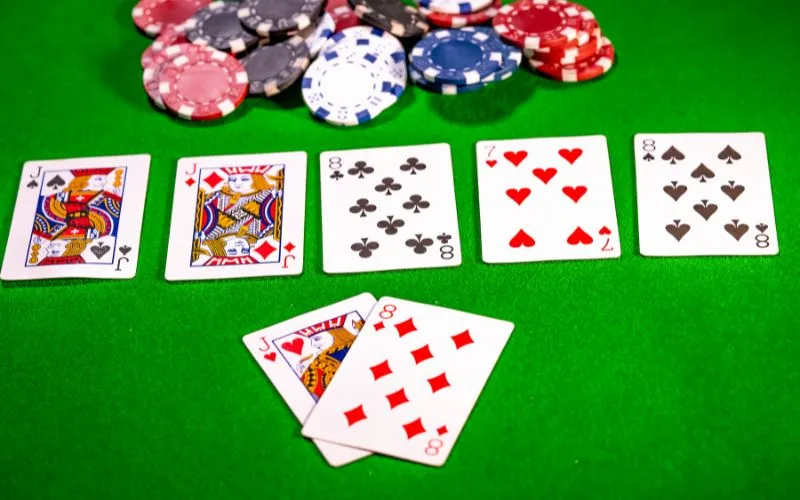
Having a full house is an excellent hand to hold when playing poker. It combines the strength of three-of-a-kind with the added value of a pair. Here are some strategies to keep in mind to increase your chances of winning with a full house.
First and foremost, it’s essential to understand the hierarchy of hands in poker and how a full house ranks. A full house is beaten only by four-of-a-kind and a straight flush, making it a strong hand worth pursuing. However, it’s important not to become overly attached to your full house if there are indications that other players may have an even stronger hand.
As with any strategy in poker, observation and reading your opponents can make all the difference. Pay attention to how other players are betting and reacting during each round. Look for clues and patterns that can help you determine whether they have a hand that could beat your full house or if they’re bluffing.
For instance, if you have a full house consisting of three Queens and two Jacks but notice another player confidently raising bets with every round, they could potentially have four-of-a-kind or even a straight flush. In such situations, it might be wise to proceed cautiously and consider folding if necessary.
Adopting an aggressive betting approach is another winning strategy for maximizing your chances with a full house. Placing larger bets when you have a strong hand like this can pressure other players to fold or give you more chips. This tactic can also help you build the pot size if others decide to call your bets.
However, remember that balance is key in poker. Being too predictable by always betting aggressively when you have a full house can lead others to catch onto your strategy. Mix up your betting patterns occasionally to keep other players guessing and prevent them from gaining an advantage over you.
Think of it like a game of chess, where strategic moves and unpredictability can keep your opponents on their toes. By varying your betting approach, you maintain control of the game and make it harder for others to exploit your strong hand.
Additionally, position at the poker table plays a vital role in decision-making. With a full house, being in a late position allows you to gauge how other players have bet before making your move. If several players have shown strength or weakness in their bets, this information can help inform your strategy.
Lastly, managing your bankroll is crucial in poker. While having a full house is desirable, there’s always the possibility of losing. Set limits on the amount you’re willing to wager and stick to them. Knowing when to fold and not chasing losses will protect your bankroll, ensuring you can continue playing strategically in the long run.
By employing these winning strategies for full house poker, you’ll be well-equipped to make informed decisions and increase your odds of success. Remember, while luck certainly factors into the game, skillful play and thoughtful strategies often separate winners from losers at the poker table.


