

Mastering Chinese Poker: Tips, Tricks, and Winning Hands
When you sit down for a game of Chinese Poker, you’re not just playing cards—you’re engaging in a strategic battle of wits and anticipation. You arrange your 13 cards into three hands, each with its own tactical significance. It’s not just about how well you know the rules but how you outthink your opponents. You might wonder, what makes this game both a casual pastime and a competitive sport? And what variations could add a twist to your next game night? There’s more beneath the surface, just waiting to be uncovered.
Key Takeaways
- Chinese poker is played with 2-4 players using a standard 52-card deck.
- Players arrange 13 cards into three hands: two five-card hands and one three-card hand.
- Points are earned by winning hands against opponents, with special bonuses for scooping all three hands.
- Variants like Open Face Chinese Poker introduce unique mechanics and strategic possibilities.
- The game originated in Asia and has grown in popularity through online platforms and tournaments.
Gameplay and Rules

How does one play Chinese poker? First, gather 2-4 players and a standard 52-card deck. Each player receives 13 cards to arrange into three poker hands: two five-card hands and one three-card hand. The rules are simple but strategic: your back hand should be the strongest, followed by the middle hand, leaving the weakest as the front hand. This arrangement is vital for effective gameplay.
During gameplay, players reveal their hands and compare them against each other’s corresponding hands. Points are earned by defeating opponents’ hands, with stakes referred to as units. The more hands you win, the more units you collect. It’s crucial to adhere to the rules when arranging your cards to maximize your scoring potential.
Chinese Poker involves different scoring methods, such as the 2-4 and 1-6 systems, influencing how points and units are distributed. Winning multiple hands or having particularly strong hands can earn you additional units, adding to the excitement and competitive nature of the game.
With these strategies and rules in mind, you’ll find Chinese Poker an engaging and challenging card game that tests both your luck and skill.
Scoring and Royalties
As you become familiar with arranging your hands in Chinese Poker, understanding scoring and royalties becomes key to mastering the game. Each player aims to earn points by winning hands against opponents. A player can score by winning two out of the three hands, and scooping—winning all three hands—often grants bonus points in certain scoring systems.
Royalties are another layer to the game, rewarding players for forming specific strong hands. These extra units are given for impressive combinations like a straight flush or four of a kind. To make the most of royalties, you must follow specific rules for declaring hands before revealing them. This guarantees fairness in how royalties are distributed.
Consider the following essential points:
- Winning Hands: Gain points by winning two or more hands against opponents.
- Bonus Points: Scooping all three hands can earn you bonus points.
- Royalties: Strong hands such as straight flushes and four-of-a-kind earn extra royalties.
- Declaring Hands: Properly declare your hands to guarantee you receive all possible royalties.
Popular Variants
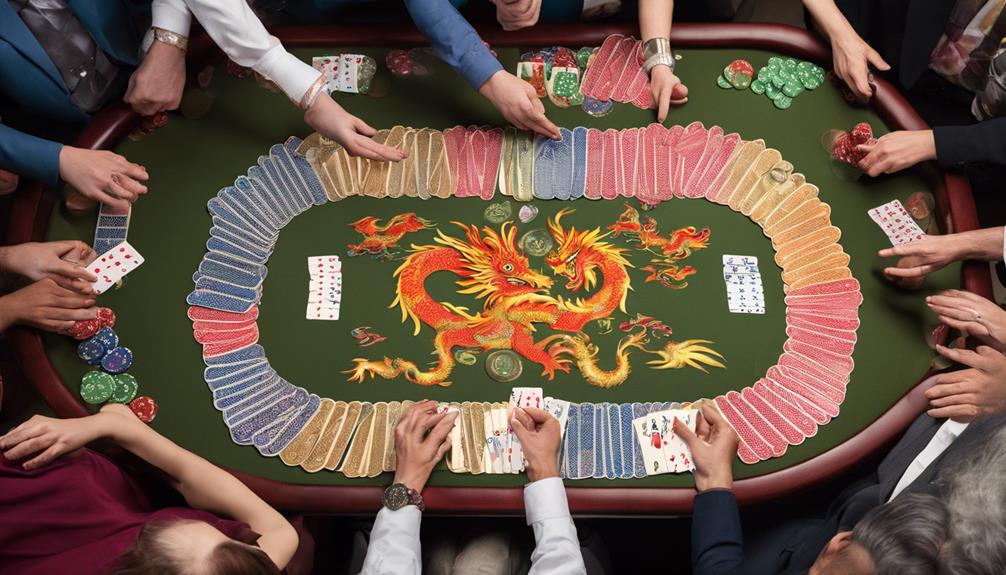
Chinese Poker offers an array of popular variants, each adding its own twist to the gameplay.
Open Face Chinese Poker (OFC) stands out by dealing five cards at a time, requiring you to set your poker hands with face-up placement restrictions. The thrill comes as you strategize your front hand, trying to maximize your three-card hand. If you play your cards right and manage a three-of-a-kind up front, you could earn three points, stacking up a rewarding lead.
The Pineapple variant spices things up with the chance to draw and discard cards, pushing you to think ahead as you set your hands. You might find yourself in Fantasy Land if your backhand wins big, giving you a unique advantage in future rounds. This adds a layer of excitement that’s hard to beat.
For something different, the Low in the Middle variant lets players explore a different strategy where the house in the middle dictates play.
Meanwhile, the Criss Cross variant introduces a fresh hand layout and scoring system. You’ll appreciate the strategic depth these variants bring, as seen at top-tier events like the World Series of Poker.
History and Popularity
Renowned for its unique structure and strategic depth, Chinese poker originated in Asia and is also known as Pusoy or Russian Poker. It gained traction in the poker community during the 1990s, quickly becoming a favorite among professionals. The game’s appeal lies in its strategic elements, challenging players to outthink opponents in various ways.
As its popularity grew, Chinese poker began to feature prominently in tournaments worldwide, showcasing its global appeal and competitive nature.
You might be interested in knowing that:
- Chinese poker tournaments attract players globally, highlighting its competitive nature.
- Professionals favor the game for its strategic depth and unique challenges.
- Online platforms have embraced the game, allowing worldwide participation.
- Variants like Open Face Chinese Poker (OFC) and Pineapple add layers of strategy and excitement.
These variants bring fresh dynamics to the game. Open Face Chinese Poker (OFC), for instance, requires you to manage your hands with foresight and precision, while Pineapple introduces an extra card, opening up new strategic possibilities.
As you explore these options, you’ll find the game’s depth both challenging and rewarding, whether you’re playing casually or in a competitive setting.
Online Presence

The digital world has greatly expanded Chinese poker’s reach, making it accessible to players worldwide through various online platforms. Whether you’re a seasoned pro or a curious newcomer, Chinese poker’s online presence offers an enticing avenue to explore this intriguing card game. You can immerse yourself in a multitude of stakes and formats that cater to different skill levels and preferences, guaranteeing there’s always a game that fits your style.
Online platforms host a variety of Chinese poker games, from cash games to thrilling tournaments. These platforms provide a convenient way to engage in competitive play, allowing you to test your skills against opponents from across the globe. The variety of formats available ensures that you can always find a game that matches your competitive spirit, contributing to a dynamic and growing community.
As the online presence of Chinese poker continues to expand, you’ll find countless opportunities to join this vibrant community. With diverse game options and easily accessible platforms, you can enjoy the game whenever and wherever you choose.
Whether you’re aiming for high stakes or want to enjoy a casual game, Chinese poker’s online platforms have something for everyone.
Conclusion
You’ve explored the strategic realm of Chinese Poker, understanding its gameplay, scoring, and intriguing variants. As you immerse yourself in its rich history and widespread popularity, you see how this game captivates both casual players and serious competitors. With online platforms, you can easily join the global community, test your skills, and enjoy the thrill of the game anytime. Embrace the challenge and camaraderie that Chinese Poker offers, and let it become your favorite pastime.


