

How to Beat Beginners at Poker: Unleash Your Winning Edge!
“I don’t need a lesson on how to beat beginners at poker. They don’t know what they are doing!” Unfortunately, that same inexperience can be to the new players’ advantage because, in a single poker session, luck can work against you.
It’s important to remember that, just like in any poker session, you should be making decisions based on expected value. You can sometimes get unlucky against a beginner because they are not playing poker “correctly,” which can sometimes be frustrating. However, when you’re playing against inexperienced players who make many mistakes, you will make major profits in the long run.
Typical Beginners Tendencies
New poker players have easily recognizable tendencies in their play that you can capitalize on. For this lesson, we will identify those tendencies using information from other studies on Pokerology, such as our list of typical beginner mistakes. Then we’ll provide some effective poker strategies that you can use against these players, which should yield major profits.
The Beginner Who Plays Too Many Hands
This type of beginner is very easy to spot. They often easily dominate hands like Ace-rag, K-8, Q-5, or any suited cards. They will limp into many pots and call a raise “just to see the flop.” Calling a re-raise out of position with a hand like K-J or A-rag is commonplace. Depending on if they are capable of folding or are a calling station, there are different ways to play them pre-flop:
- Capable of folding – if you have a position, raise with a wide range of hands and bet the flop if they call pre-flop and check with you. If they call, they usually have a piece or a draw, and you can slow down depending on your hand.
- Calling station – consider limping behind pre-flop with your hands. You might raise others to keep the pot small since you shouldn’t be bluffing them much pre-flop.
- Open up the range of hands that you would normally put someone on. Because they are new, you can’t assume they always play a standard needle.
The Beginner Who Gets Committed To a Hand
Beginners tend to call stations and table sheriffs, so look for them to reach bets on all streets with easily beaten hands. For example, they are going with a hand like 7-7 on an A-K-T flop or calling large bets with middle pair.
- NEVER bluff a calling station – they will pay you off enough when you have a hand.
- If you have a strong hand, don’t slow play. Bet as much as you think they will call.
- If they ever raise, beware; they usually have a strong hand, so play cautiously. Often, this occurs when they have sucked out to hit two pair.
The Beginner Who Chases
The beginner who likes to chase can be easily identified. They consistently call bets on draws without getting the proper odds (even gut-shot draws). They will track over-cards Ace high and call quickly on a tie.
-
-
- Charge them to draw – as much as you think they will call. Don’t bet to “protect your hand.” They will miss their draw more than they will make it, so make them pay for it.
- Tread cautiously if a flush or straight draw hits.
- If they seem to be chasing and make a big river bet when a draw misses, consider making the call if you have a decent hand.
-
The Beginner Who Bluffs Too Much
Keep an eye out for the beginner who makes large bets or raises that don’t make sense. This type of beginner will continuously make plays at pots without regard to his table image. This player will typically try to appear aggressive and show strength with physical poker tells (if playing live).
- If you see a pattern, be prepared to go with your instinct and make calls of big bets that don’t make sense. While advanced players can often make a large bet representing a bluff, this is not typical for beginners.
- Also, note that beginners will often make large bets when they have a big hand, but the important thing here is observing a bluffing pattern.
The Beginner Who Plays Passively
Be aware of the passive beginner who doesn’t play many pots and will often call pre-flop. If they do raise pre-flop, they usually check it down if they missed with over-cards (i.e., Ace-King). They often lift the minimum with marginal hands for fear of losing chips if they get beat – and usually fold to scare cards. Due to a lack of experience, they play with a fear of losing and will only stay in a pot if they have a strong hand.
- If they have not shown aggression, bluff them at will.
- If they limp pre-flop or bet small, raise with various hands.
- Stay out of the pot if they are betting strong or raising unless you have a strong hand.
- Bet scare cards (i.e., Ace on board or made flush).
- Use scary bet sizes that represent monsters (this could be overly small or big bets).
- If you are in the blinds, you can call a raise if they are in a late position and bet any flop. You will know immediately where you stand and can often bluff them out of the pot.
The Beginner Who Bets Based on Hand Strength
Beginners often bet larger with stronger hands and smaller with their weaker hands, especially on the flop. They often limp or raise small with Aces, Kings, and Queens because they think building the pot with many people is smart.
- Watch for predictable patterns and play poker based on the value of your hand vs. the hand you put them on.
- If they are betting weakly, they are likely weak, and you can decide if you want to bluff or bet for value based on their psychological tendencies.
- Watch for a small raise pre-flop followed by very large bets on the flop. This is often a sign of a big pocket pair.
Hand Example
- No Limit Hold’em Tournament Play
- Blinds: 25/50
- You and your opponent both have 3,000 in chips.
Reads
Your opponent has been involved in many pots, limping into most and raising with his big hands. He’s already been going up and down in chips in the early stages of the tournament. Based on how many pots he’s limped into and the types of hands he’s shown down on the river after calling every street (i.e., top pair/low kicker, bottom pair, missed draws), you can tell he’s a beginner. The pots he has won were because his opponents were misplaying their hands by trying to bluff him or because he’s hit a draw to a flush or straight. When he did catch a card to make a draw, he immediately pushed it all in.
Pre-Flop
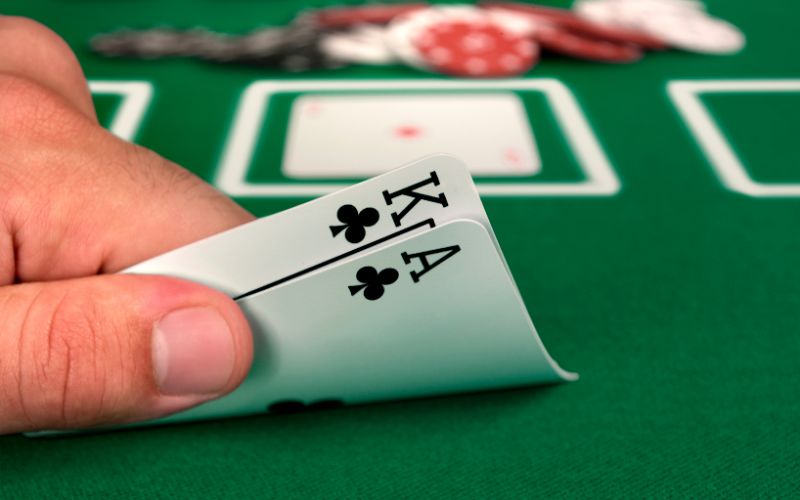
Your opponent is under the gun and, as usual, limps into the pot. This range could be wide based on how many hands he’s played. One other player with 1,500 chips limps in the middle position, and in the cut-off, you look down to see
How should you play this hand?
Based on past behaviors, the UTG opponent wants to see the flop and will call most raises. At the same time, while AK is strong, it will often miss the loss, and you will have a hard time pushing your opponent off if he catches any piece. Because of that, limping is an option, as it will disguise the strength of your hand and control the pot size. So should you crawl? Sometimes, this might be an okay way to mix up your play, but “disguising” and “mixing things up” only have value against someone paying attention to your playing. In this case, the UTG player is a beginner, only playing his cards. Another reason not to limp is the presence of other people in the pot. Your limp will encourage others behind you to crawl, and they can easily catch a hand. Ace-King is also too good of a hand not to raise for value.
So the decision is to raise, but how much? We know the beginner will likely come along for the ride, but we also want the other players to fold. We would much rather play this hand against one person if we can. We also want to exercise some element of pot control because AK could easily miss, and a continuation bet on the flop may not be as effective against the beginner. With the blinds at 25/50 and another limper already in, I would raise it to around 250. The button and blinds fold, the UTG beginner player calls, and the middle position player folds. Perfect.
The Flop
The pot now has 625, and the flop comes. Then our opponent bets out 200:

This should be a good flop for us. He’d probably have raised pre-flop with AA or JJ and may have submitted with AJ, so if he has us beat now, it’s only with 44 or AJ. Based on the size of the bet, it’s most likely that he has a small piece of it. It’s enough to proceed as if we have the best hand confidently. Because of the flush draw, he would more likely have bet around the pot size with a set of 4s or AJ. He could be betting on a flush draw, but most beginners with his tendencies would more likely check/call with interest after facing a raise pre-flop. We can safely narrow his range to any Ace or a pair of Jacks (J8-KJ is most likely unless it’s suited).
Now, how do we extract the most from this situation? Pushing it all in might scare him off, so let’s eliminate that. Slow playing might be best against some players, but not against a beginner. Again, he’s not thinking about what we have. He will likely call a raise if he’s only thinking about having a pair. He’ll call thinking two things: 1. this guy is trying to push me around, 2. even if I beat now, I could catch another card to win.
So let’s raise. Based on the range we are putting him on, we know he’s likely drawing between 3 and 5 outs (3 outs if he has an Ace with a smaller kicker and five releases if he has a pair of Jacks). In poker, we win if we can cause our opponents to make an incorrect decision. It would be wrong if he calls any raise because he needs at least 8.17 – 1 odds. In this situation, I would raise it to around 800. After his 200 bets and our raise, there will be 1,625 in the pot, which will cost him 600 to call, giving him about 2.7-1 odds. Remember, though, he is not thinking about the odds; he’s thinking about how reasonable the bet size is, and we want him to reach the maximum.
The Turn
The turn is a, and the pot has 2,225. Our opponent immediately pushes all-in for his remaining 1,950:
Wow! How can we get away from this hand? Well, it’s not as hard as it seems. First, we are experienced enough that we aren’t getting attached to our writing, right? Okay, so forget that we have a top pair and kicker. Let’s keep narrowing down our opponent’s range of indicators. We know he most likely has an A-rag or a pair of Jacks. Our opponent has not shown aggression in previous hands in previous hands unless he has a big hand or hit a draw and has just called with his marginal hands. Also, because he’s a beginner, there is no reason that we should think he is running some advanced bluff.
Taking that all into consideration, there is a high likelihood that he has sucked out, and we are now beaten. His most likely holdings are A9, J9, and 99. We still have outs vs. A9 and J9 and are drawing dead to 99. There are now 4,175 in the pot, costing us 1,950 to call, giving us 2.15-1 odds. We aren’t getting the right price to re-suck, and we should fold. We fold, confident in our read, and our opponent shows us for two-pair.
Conclusion
Next time you play against a beginner, try to observe their actions. It shouldn’t be difficult to get a read on them because, as we’ve shown in this lesson, beginners have easy-to-recognize tendencies in their play. They won’t be making advanced plays on you; what you see is what you get.
It’s important to realize that they are not playing you but only playing their cards. Therefore you should play “ABC” poker against these players because they won’t learn you are running some advanced play on them. Be careful not to get caught up in fancy play syndrome. Beginners don’t think about what you are thinking or what hand you are representing – they know that they have a pair that could be good, so that they will call any bet.
If you remember this, then you will make money against beginners in the long run.
Related Lessons
- Typical Beginner Mistakes
- Value Betting
- Understanding Expected Value
- Reading Betting Patterns


