

Poker Tells That Matter: Secrets to Winning Big!
Talk to a friend or acquaintance who doesn’t play poker. Ask him what he thinks are the two or three most important things to learn about the poker game. I am willing to bet that he mentions either bluffing or “tells” – those things that players unconsciously do that tend to give away the true strength of their hand. Think I’m wrong?
The Myth of Overvaluing Poker Tells
I’ve dealt with bluffing in other articles – and I’ll deal with it again, but not here, except to say that, generally, for most low and medium-limit players, winning poker play depends much less on bluffing than most people think.
Similarly, I think the public, and many poker players, tend to greatly overestimate the importance of finding those unconscious poker tells that typically give away the true strength of an opponent’s hand. Let me explain how that is so – and in so doing, help you focus on what is important in figuring out your opponents’ hands.

There surely are things that poker players do unconsciously that tend to give away their hands. New players and awful amateurs may smile when they like the way their hand looks, and they may curse when they don’t want their writing. Some complete newbies show emotion on their faces, obviously and directly. These are poker tells that can be exploited to be sure.
The Illusion of Subtle Poker Tells
However, players that are so obvious are relatively rare in a poker room or even in a regular home game. Everyone playing poker for any money knows the importance of not giving away one’s hand in this obvious manner. And few do. I’ve learned that one of the most common skills that players pick up is keeping a poker face.
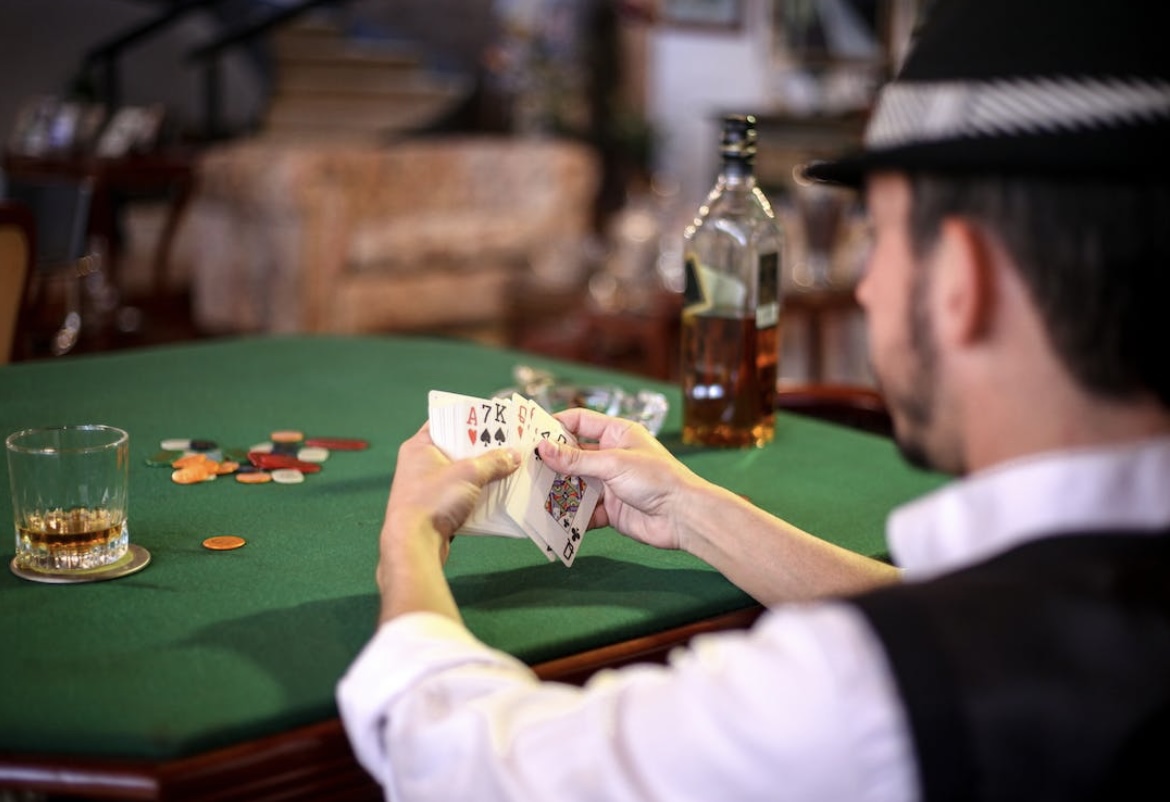
Even so, many players, especially players who have read a poker book or two and think themselves serious, expend a lot of energy trying to discern the true strength of their opponents’ hands by watching diligently for what I call that giveaway to tell. You know what I mean – the ring twirling to indicate a bluff, the lip licking to demonstrate strength, the unconscious tapping on the table when impatient because of bad cards.
Player Profiling: Unlocking Poker’s Edge
Without ruling out some slim possibility of importance in these types of unconscious behaviors, for the most part, they are the stuff better left to movies. More important in the low and medium games that most of us frequent are the conscious things players do when playing poker. Put players into broad categories that define their style of play, and you’ll be much better able to determine the true strength of their hand than by relying on any of their unconscious behavior.
Here’s an analogy. During WWII, the British were trained to spot enemy planes when they were flying over their coastline. They were introduced to identify that a plane was overhead and what type of plane. They did this not by learning all of the planes’ intricate markings and other fine features but by learning their basic silhouette. This plane outline was sufficient for the good plane spotter to identify the make and model of the aircraft – and to use that information to alert others.
Decoding Hands: Beyond Tells
In poker, it’s the same way. The unconscious tells are the fine details of the plane. They are, for the most part, a distraction. You can stare for hours at a poker player and get no useful information about what he is likely to hold. New, beginning, and intermediate poker players often don’t know for themselves the true strength of their hand. How will you figure out what they have when they don’t know?
Player Archetypes: Embrace Broad Traits
Rather, look to identify those broad characteristics that players freely and frequently exhibit about their gameplay. Do they bet and raise a lot? Mark them down as aggressive. Do they call and check more than pitch and bet? Mark them down as passive. Do they fold most of their hands? Mark them down as tight. Do they tend to be in a lot of hands? Mark them down as loose.
Poker Player Archetypes: Hand Reading Guide
Combine these traits, and you’ll come up with four basic categories for players: tight-aggressive, loose-aggressive (known generally as “wild”), loose-passive (known generally as a “calling station”), or tight-passive (known generally as a “rock”). Then use these broad characteristics to help you determine what a player has based on his betting action in a particular hand. If a wild player is betting and raising, you are less likely to credit him with a strong hand than if a rock grows or re-raises.
Decoding Player Trickery: Navigating Poker Reads
When you’ve mastered this – and can not only categorize players but remember which category they fall-you’re ready for the next step – discerning whether they are tricky. There is more gray in this exercise than in the other. Players tend to fall on a continuum that ranges between extremely tough and completely straightforward. It would be best to categorize them as somewhere on the scale and then credit their actions accordingly.
If a short, tight-aggressive player raises the big blind pre-flop from an early position, credit him with a large pair. If, on the other hand, you’ve determined that he’s a very tricky poker player, then broaden the range of hands he might be holding to include two big cards or a suited Ace. Similarly, if a straightforward player bets on the river, he tends to believe that his bet represents a hand he thinks is in the lead. Suppose a tricky player makes that same play, a figure that he may be bluffing.
Poker Player Profiling: Gain an Advantage
Tight, aggressive, passive, loose, and tricky are the simple traits you should observe and recall at the poker table. That’s enough for now. If you can with your opponents and then remember the information, you’ll be much better off than by focusing your attention on the small and unconscious things that the
When you have mastered your ability to characterize players based on their patterns and habits of betting, then, and only then, should you move on to the next step – the learning of some of the basic poker tells that many players exhibit. But that’s a lesson for another day.
Related Articles
-
- Online Poker Avatar Tells
- Assessing the Competition
- Acting at the Poker Table
- Dealing with Tricky Poker Players


