

The Basic Rules of Poker (Texas Hold’em)
There are many forms of Poker, including seven-card stud, Omaha, five-card draw, and Texas hold ’em; hold ’em has evolved as the most popular game worldwide and is the form we shall use to cover the basic rules of Poker.
In this lesson, we’ll take you step by step through the basic rules of Poker and use an example hand to illustrate. You can read the following text or watch the video version instead. Watching the video is probably the better option because it’s easier to follow the betting action, but the choice is yours.
The Setup
The game of hold’em is typically played with nine or ten players at the table.

In our example, we have ten players. The dealer button is on player 1, the blinds have been posted, and each player has received their hole cards. If this doesn’t make sense to you, don’t worry; we’ll explain exactly what this means.
The Dealer Button
The dealer button is the round disc labeled with “Dealer” or “D,” which signifies who the dealer is for the hand. Please be aware that players get to ‘act’ as the dealer, even if they don’t physically deal with the cards. After each hand, the dealer button moves to the next player clockwise. In Figure 1, the dealer button is with Player 1, but for the next hand, it’ll be with Player 2, player 3, and so on.
The dealer position is also called “the button” and is the most favorable position in the game as that player gets to act last after he has seen everyone else make their decisions. The exception to this rule occurs on the first round of betting, wherein the “blinds” will act after the button.
Blind Bets
Before any cards are dealt, the two players to the left of the dealer button must post what are referred to as the blinds. These forced and compulsory bets encourage action and give players something to shoot for. Typically there is a small blind directly to the left of the button, which posts half the size of the big blind’s obligation. The stakes of the game determine the number of blinds.
In our example, we’re using $1 and $2 blinds. In case it’s not obvious, they are called blind bets because the two players must post them before they see their cards.
The Deal
Once the blinds have been posted, each player is dealt two facedown cards, often called their hole cards. The best two-hole cards a player can be handled in hold’em are two Aces’, but we’ll discuss the importance of starting hand selection in later lessons. All you need to know for now is that the betting action can begin after the blinds have been posted and the hole cards have been dealt with.
Pre-Flop
This first betting round is called the pre-flop betting round. The first player to act is the player directly to the left of the big blind (in our example, this would be player 4), and he has three options; to call the amount of the big blind, which in our example would be $2, to raise, or to fold. If a player decides to fold, they muck (discard/throw away) their cards facedown and sit out until the next hand is dealt. The action follows around the table clockwise until each player can call, raise or fold.
The whole betting procedure of Poker can be a little confusing for beginners. In our example hand, you can see that players 2 and 3 have posted the blinds. If all the players to the left of player 3 decide to call the $2 bet, then the action is on the small blind, player 2, who has only posted a small blind of $1. He now has the option to call $1 more to make up the bet, or he can raise it. If he reaches the extra $1, the big blind is left with the final option. Since the blind bets are made before the cards are dealt, they are considered “live,” which means that even if all the other players call the big blind, he still has the option to raise if he wishes. If the big blind doesn’t want to grow, the betting round is over, and we can move on to the flop, which we’ll explain in a moment.
What if a player decides to raise? If a player chooses to submit the big blind bet of $2, all the remaining players must either call the new chance, re-raise or fold.
In our example, player 6 raised the betting to $4, and player 7 folded and is now out of hand. Player 8 called, but players 9, 10, and 1 all folded and were also out of this hand—players 2, 3, 4, and 5 all called player 6’s raise. The betting round is over once all bets have been equalized (i.e., matched). In our example, six players are left,d the pot contains $24 ($4 x 6). This brings us to the next betting round, called the flop.
Do you have other poker questions? We fully recommend reading the book Unfolding Poker and getting usable answers that you can use in your NEXT session.
And if you enjoy audiobooks, grab the audiobook combo and turn your next drive into a coaching session!
The Flop
After the first betting round, three community cards are dealt face-up in the middle of the table. All active players can use these three and their two-hole cards to make their best possible hand. These three cards are known as “the flop.” Here’s the flop before any further betting has taken place:

All the bets from the previous round (pre-flop) are now in the pot. After the flop has been dealt, another betting round begins. The first active player to the left of the dealer button starts the action. In our example, this is the small blind from the opening round, player 2. The forced activity created by the blind bets no longer exists, and that player has two options; to check or bet. A check means to open the betting or fold either. When a player checks, the action moves to the next active player, who may also contain. If players want to check, they either verbally announce “check” or tap the table with their finger or hand (or click the mouse if playing online Poker).
If a player decides to open the betting, the option to check is over, and a player must either call, raise, or fold – this includes any players who have previously studied. Once all bets for this betting round have been matched or every player has opted to contain, we move on to the next round. For our example hand, suppose that players 2, 3, 4, and 5 checked after the flop was dealt. But player six then bet $2, which was called by player 8. Players 2, 3, and 4 all fold, but player 5 calls the $2. These three players get to see “the turn.”
The Turn
After the second round of betting (the flop), a fourth card is called “the turn” – sometimes called 4th Street. In our example hand, we have three players remaining:

You will also notice that the pot now contains $30, and $24, from the first betting round, and $6, from the betting on the flop. After the fourth community card (the turn) has been dealt with, another round of betting takes place, the same format as the previous betting round, starting with the first active player to the left of the dealer button. In our example, this would be player 5. He may check or bet. Let’s suppose that player five checks, as do players 6 and 8. If all the players check, the round is over, and we move on to “the river.”
The River
After the third round of betting, the fifth and final board card is called “the river” – also sometimes referred to as 5th Street.
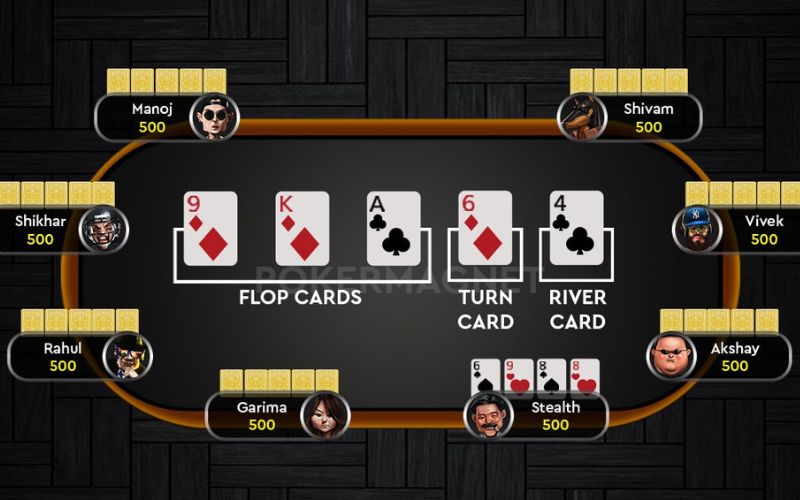
In our example hand, there is $30 in the pot, and player five bets $4. He’s raised by player 6 (who makes it $8 total). Suppose that player eight folds and player 5 decides to call the extra $4. When the final betting round ends with two or more active players (as our example has done), we get to a “showdown.”
The Showdown
After the final betting round, it’s time to see who has won the hand and the money in the pot. Now that all the cards have been dealt, each player can combine their two-hole cards with any of the five cards on the board to create their best five-card poker hand. The winning hand must be seen so that players can reveal their two-hole cards. The player that was called (player 6) is required to show first. Figure 7 shows an example showdown after both players have demonstrated their hole cards:
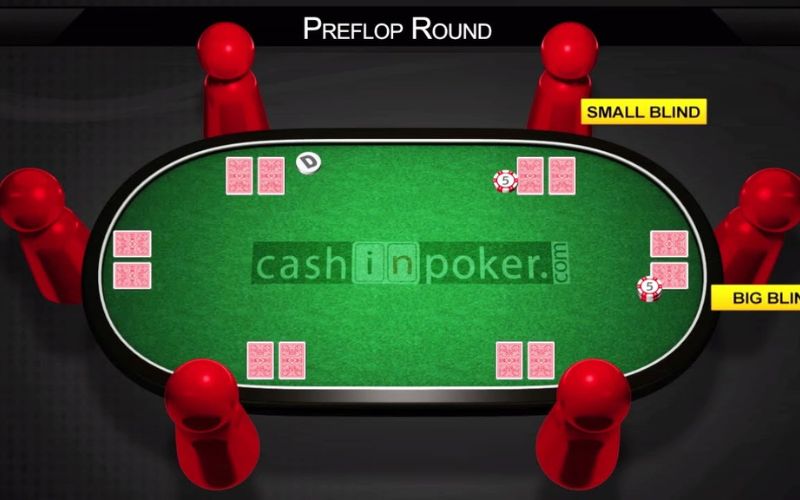
Which hand wins? Player 5 has a straight (9, T, J, Q, K), and player 6 has a higher straight (T, J, Q, K, A), but his best hand is a flush (A, K, Q, T, 5 of hearts). If you studied the poker hand rankings lesson, you would know that a flush always beats a straight. Therefore player 6 wins this hand, and as you can see in Figure 6, after the final betting on the river, the pot now contains $46. Player 6 wins the jackpot of $46, and a new hand can begin.
Some Important Points
In our above example, it was mentioned on more than one occasion that not all hands will reach the point of a showdown. You must realize that a hand of Poker can be over even before the players see the flop. Our example hand made it to a showdown, but if a player had made a bet which wasn’t called during any of the betting rounds, then this player would’ve won uncontested. Think of it like a boxing fight, where a fighter could land a knockout blow in the first round, or both boxers could still be standing after 12 games, in which case it’d be decided on points.
It’s also worth noting that you are not obligated even to use your two-hole cards if you get to a showdown scenario. If the best five-card hand you can make comprises the five community cards, you are said to be playing the board. For example, if the five community cards (flop, turn, and river) made up a Royal flush, the best possible hand in Poker, all the remaining active players would share the pot, regardless of their hole cards. Even though each player has seven cards in total, only five of them count – your best five.
Once you understand the basic rules of Poker, it’s time to start building a powerful strategy. See how our friends at Red Chip Poker created the perfect course to give you the ideal playbook…
Of course, you need to understand many other rules and important concepts, but hopefully, you’ve learned a lot from this lesson. The game of Texas Hold ’em is deceptively simple. Still, as you move through the myriad of poker lessons here on Pokerlogy, you will experience an astounding wealth of information and strategy.


