

The Ultimate Guide to Ranking the Best Poker Hands in Order
Knowing the best poker hands in order is fundamental to your strategy when you sit at a poker table. You’re likely familiar with the Royal Flush, the pinnacle of poker hands, but how often do you consider the subtleties that differentiate a Full House from a Flush? Each hand is uniquely positioned in the poker hierarchy, influencing your play and betting strategy. As we explore these top-tier hands further, you’ll discover why even slight variations in your hand can greatly impact the outcome of your game. So, let’s unpack these nuances together and sharpen your approach to poker.
Key Takeaways
- Royal Flush is the highest poker hand, consisting of an Ace, King, Queen, Jack, and Ten of the same suit.
- Straight Flush follows, featuring five consecutive cards of the same suit.
- Four of a Kind is the third strongest hand, where four cards are of the same rank.
- Full House combines three cards of one rank with two cards of another.
- Flush, made up of five cards of the same suit, is the fifth strongest hand in poker.
Understanding the Royal Flush

The Royal Flush, the highest poker hand, consists of the Ace, King, Queen, Jack, and Ten of the same suit. It’s not just a rare combination; it’s the golden ticket in poker, an unbeatable hand. You’re probably wondering about the Royal Flush probability. The odds of snagging this prestigious hand are incredibly slim—about 1 in 649,740!
Now, let’s dive into the Royal Flush origins. This hand’s history is as rich as its value. Rooted in poker, which evolved from several card games in the 19th century, the Royal Flush emerged as the ultimate emblem of luck and strategy. Originally, poker was played with just 20 cards, and the concept of a flush was nonexistent. As the game evolved, the 52-card deck was introduced, and with it, the flush. The Royal Flush became recognized as the pinnacle of best poker hands in order, a symbol of rare and perfect alignment in the game.
Exploring the Straight Flush
Just below the Royal Flush in the hierarchy of best poker hands in order, you’ll find the Straight Flush, a powerhouse in its own right. Understanding the Straight Flush is essential for strategizing your plays as you explore the poker world. This hand consists of five consecutive cards, all in the same suit. The beauty and rarity of this hand come from its suit patterns, which must align perfectly.
The Straight Flush sits atop most other hands, beaten only by the Royal Flush. Now, you might wonder about the straight flush odds. Here’s the deal: the odds of hitting a Straight Flush are quite slim, approximately 1 in 72,193 in a standard game of Texas Hold’em. This rarity makes the Straight Flush such a revered hand in poker circles.
When you’re playing, watch the developing suit patterns on the table. If you notice a potential lineup for a Straight Flush, consider how the other players are betting. Are they confident or hesitant? This might give you a clue about whether pursuing the Straight Flush is a gamble worth taking or if you should hold off for a safer play.
Decoding Four of a Kind

While the Straight Flush is a rare gem, Four of a Kind is another formidable hand you should aim to master. Often overshadowing many other strong hands in poker, Four of a Kind consists of four cards of the same rank, leaving your opponents with slim chances of beating you. Understanding the Four of a kind odds is important. Statistically, you’re looking at a 0.024% probability of hitting this powerhouse hand in a standard game of Texas Hold’em, translating roughly to odds of 4,164 to 1.
The significance of the kicker in Four of a Kind can’t be overstated. Since poker games often involve multiple players achieving high-ranking hands, the kicker—the fifth card that isn’t part of the four similar ranks—plays a pivotal role. It’s your tiebreaker and could be the difference between scooping the pot or splitting it. Ensure the kicker is as high as possible to avoid unnecessary showdown surprises.
The Power of a Full House
Dominating many poker tables, a Full House combines three cards of one rank with two cards of another, offering you robust winning potential. This hand ranks highly and deeply impacts how you and your opponents play the game, weaving in full house dynamics and psychology.
Consider the way a Full House can shift the energy at the table:
- Strength Perception: You’ve got a hand that commands respect. Opponents often assume you’re holding something less powerful, which can lead to profitable situations.
- Bluffing Leverage: Holding a Full House allows you to bluff confidently if the community cards suggest other potential hands. Your opponents’ uncertainty is your gain.
- Decision Pressure: When you reveal a Full House, it puts immediate pressure on your opponents, forcing them to make tough decisions about their own hands.
- Psychological Edge: Understanding the psychological impact of showing a strong hand like a Full House can help you manipulate the game flow and player actions.
The Flush Breakdown
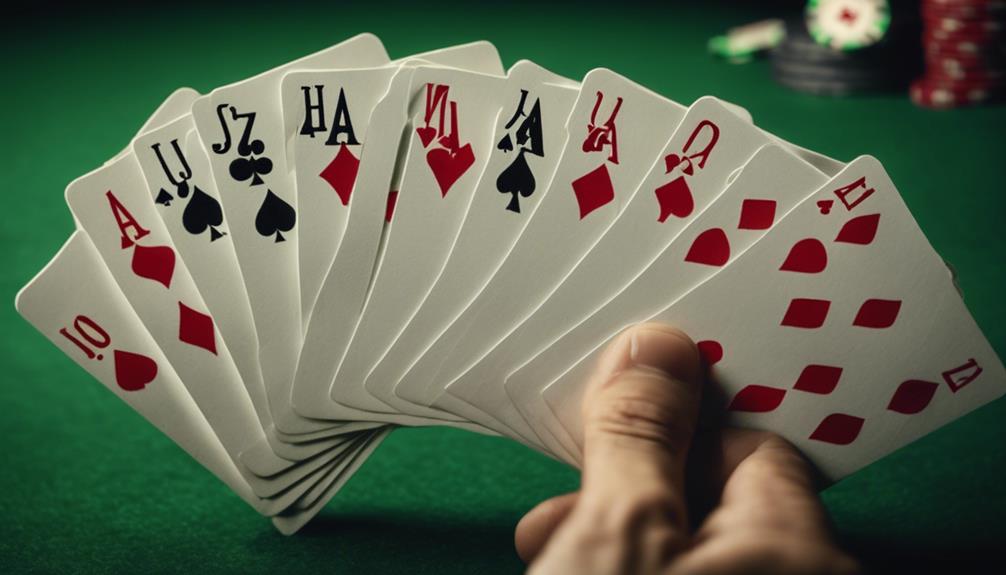
A Flush, comprising five cards of the same suit, often sweeps away less cohesive hands at the poker table. Understanding its variations and odds is key to mastering this strong hand. The Flush isn’t just about having five cards of the same suit; the variations can dramatically affect your strategy and outcomes. For instance, a Flush with high cards like Ace or King is much stronger than one with lower cards. You’ll find that the difference between holding a King-high Flush versus a 5-high Flush can be monumental regarding your success at the table.
Calculating the odds of hitting a Flush also adds another layer to your game. When you’re dealt two suited cards, the odds of flopping a Flush are about 0.8%, but the odds improve to around 6.4% by the river. This means that while it’s not uncommon, you’ve got a decent shot by the river if you’re drawing to a Flush. Remember, your chances vary depending on how many cards of your suit are already visible on the table, so keep a sharp eye on the board and adjust your expectations accordingly.
The Strength of a Straight
Even if a Straight doesn’t match the power of a Flush, it still presents a formidable hand that can lead you to victory in many poker games. Understanding the strength of a Straight can greatly enhance your strategic play. Here’s a concise look at why a Straight is a hand you don’t want to underestimate:
- Versatility in Formation: You can form a Straight with any combination of suits, which provides flexibility in building your hand.
- Decent Probability: While not as high as some other hands, the Straight probability balances rarity and attainability. It’s more common than a Flush or Full House, giving you a reasonable chance to hit it.
- Impact in Head-to-Head: In head-to-head situations, a Straight often holds up well against lower-ranked hands, giving you a solid edge.
- Strategic Depth: Knowing when and how to play a Straight can add depth to your game strategy, especially considering the various straight variations like the Wheel (Ace to Five) and Broadway (Ten to Ace).
Three of a Kind Insights

Why should you value a Three of a Kind in your poker strategy?
This hand, consisting of three cards of the same rank, balances rarity and strength, making it a powerhouse in many situations. Understanding its hand frequency is key; it’s not as common as a pair, for example, but it appears often enough to be a significant factor in your gameplay.
Three of a Kind can often win pots, especially in games with many players where higher-ranking hands like straights or flushes are less likely to occur. However, the real game-changer can be your kicker. The kicker’s importance can’t be overstated because it often decides the winner when opponents have the same Three of a Kind. This makes your choice of starting hands critical. You’ll want to play cards that have the potential to make trips and offer high kickers.
You’ve got a stealth weapon when you’re dealt three of a Kind, especially in community card games like Texas Hold’em or Omaha. Opponents mightn’t see it coming until the showdown, giving you a psychological edge. So, always consider how your hand might develop, and remember, those kickers are as vital as the trips themselves.
Two Pair Strategy
Holding two pairs in your hand can significantly strengthen your position at the poker table, offering a solid chance to outplay the competition. When you have this hand, your strategy should adapt based on the game’s context and your understanding of the opponents’ tendencies. Positional play and bluffing techniques are vital in maximizing your advantage with two pairs.
Here are a few strategies to keep in mind:
- Evaluate your position: Playing from a late position allows you to observe others’ actions before you move. Use this information to your advantage, deciding whether to raise or call based on the strength shown by others.
- Control the pot size: If you’re unsure about the strength of your two pairs compared to possible hands on the board, manage the pot size to minimize losses.
- Bluff effectively: Occasionally, use bluffing techniques to represent a stronger hand. This can push opponents with weaker hands or similar strength to fold, securing you the pot.
- Be wary of draws: Watch for potential flushes or straights that could defeat your two pairs. Adjust your bets accordingly to protect your hand or cut your losses.
These strategies will enhance your gameplay and increase your chances of coming out on top with two pairs.
Evaluating the High Card

After mastering two-pair strategies, let’s focus on understanding the significance of a high card in your poker hand. When all else fails, and you’re left with no pair, straight or flush, your high card is what you’re counting on. It might seem like a weak hand, but it’s got its own set of vital strategies and essential tie-breaking rules.
Tie-breaking rules are pivotal when two or more players have high card hands. Here’s how it works: the highest card in your hand is compared to the highest card in your opponent’s hands. If those are the same, you move to the next highest cards sequentially until the tie is broken. For instance, if your highest card is an Ace and so is your opponent’s, but your second highest card is a Queen, and theirs is a Jack, you win.
It’s important to note that suit significance comes into play primarily in other forms of poker, like stud games, where suits can be ranked from highest to lowest as spades, hearts, diamonds, and clubs. In Texas Hold’em and most other standard variations, suits don’t affect the strength of a high card hand. Remember that every card counts when a thread hangs your hand’s strength.
Conclusion
Now that you’ve explored the hierarchy of best poker hands in order, you’re better equipped to strategize and win. Remember, starting from the unbeatable Royal Flush to the humble High Card, each hand has its unique strengths.
Focus on building the best hand and reading the table and your opponents. Keep practicing and refining your skills. Whether aiming for that perfect Royal Flush or just trying to outsmart with a High Card, every game is a new opportunity to shine.


