

Demystifying the Enchanting World of Expected Value Calculation
Before you get scared that this poker lesson is all about complex math, it’s not. Yes, we’ll cover some of the calculations used to determine expected value in some common situations, but EV is just as much about a mindset as it is math. Instead of just thinking, “I’m ahead” or “I’m behind, “the EV mindset is about putting your opponent(s) on a range of possible hands and developing a habit of quickly analyzing each possible decision and picking the one that will make you the most money in the long run.
As we take your understanding of expected value to another level, additional criteria that will affect your decisions’ long-term profitability must be incorporated. The following are the primary criteria you will use in thinking about expected value:
- What is my opponent’s likely hand range?
- How likely is my opponent to fold if I bet?
- How likely is my opponent going to bet in this situation?
- How likely is my opponent bluffing in this situation?
- How possible is my opponent value betting in this situation?
- How likely will my opponent call with a hand I’m beating?
- How probably will my opponent fold a better indicator if I bet?
- What will my stack size be as a result of my decision?
- What are the odds of improving my hand?
- What are my implied odds if I hit the card I seek?
Common EV Situations
One of the most common tournament poker scenarios where knowledge of expected value comes into play is when you’re short-stacked and decide to shove all in or fold. Calculating your fold equity and the pre-flop ranges of your opponents is crucial. But, the factors that will dictate your decision include:
- How much do you win in blinds and antes if you’re not called
- How often you’re going to get called
- How wide is your opponent’s calling range is
- Your hand and how it fares against your opponent’s range
- How much do you gain if you get called and win
- How much do you lose if you get called and lose
Your table image, opponents’ images, stack size, and the stack sizes of the players left to act will play a big role in your opponent’s calling range. A very large stack size might decide to gamble more to bust you out, while a very short stack might feel desperate to double up, which may have a larger calling range. Of course, a looser player will have a wider calling range, whereas a tight player may only call with premium hands.
Hand Example – Playing Against a Polarized Range
Let’s look at a few different hand examples and show how understanding expected value will help you earn more profit over the long run. This first hand is from a no-limit cash game with blinds of $0.50 and $1.00. Both you and your opponent started the hand with around 100 big blinds.
Pre-Flop / the Flop
It folds around to your opponent in the cut-off, and he makes a standard 3x raise. Your opponent has been betting with a wide variety of hands and is a very aggressive player. You’re on the button, and while you play your hand in various ways, you decide to flat-call in position. The blinds both fold and the flop comes. Your opponent makes a standard continuation bet of $4.50, just over half the pot.
You have middle pair on an Ace high board that’s quite coordinated. You also have the, which is good as it gives you some backdoor outs in case your opponent has an Ace. Although there are times when he could have an Ace, it’s likely to bet the Sith a wide variety of hands since he’s a he’s aggressive player. Although, in this situation, there isn’t machinate raising because there is still a good chance he has an Ace, in which case he’d call he’d grow. So you decide to flat call and use the advantage of position.
The Turn & River
The turn card brings the and your opponent checks. He could be afraid of us having KJ, but maybe he’s just he’s-controlling with a weak Ace, perhaps fearful that we also have an Ace with a stronger kicker. With him checking, we can be fairly confident that he doesn’t have doesn’t hands like AA, KK, or QT – since it’s more it’s, he’d choose bet for value and want to charge us for possibly chasing a flush draw. So his range is fairly polarized from Aces to bluffs in this hand and, more likely, semi-bluffs. You decide to check, and the river is, which leads your opponent to push out a bet of $8 into the $16 pot.
Now you have to ask yourself… do I call? Am I getting the right pot odds and the equity versus his range of hands to make this a profitable call in the long run? There will be times when he shows up with AT or A9 and is betting for value – in this case, you can look somewhat stupid if you call and he does have an Ace. But remember, he is an aggressive opponent who could just be trying to get you to fold – perhaps a busted flush draw. So he has a polarized range; betting for value with an Ace, slow-playing a monster, or he has absolutely nothing. Let’s lookLet’she the expected value of this situation.
Pot Odds: $24 in the pot / $8 to call = 3-to-1. Correcting at least 1 out of every four times would be best. It would be best to have 25% equity to be profitable versus his likely range of hands.
50.342%
49.658% { KK+,22,A2s+,QTs-Q9s, T7s+, 96s+, 85s+, 74s+, 64s+, 54s, A2o+, QTo-Q9o, J9o-J8o, T8o+, 97o+, 87o.
These equity figures were calculated using Poker Stove – a very handy software that will help you analyze your hands and determine the maximum EV of each situation.
I included a wide variety of suited connectors, connectors, one gapped card, and hands he could have c-bet bluffed with on the flop, gave up on the turn, then bet the river because we didn’t act didn’t turn. Even if you remove some bluffing hands from his range, it’s much it’s than the 25% you need. Therefore this call — has the expected value.
Hand Example – Blind vs. Blind
This next-hand example is a blind vs. blind confrontation from a no-limit hold ’em tournament. You have been playing fairly tight and have not made any recent moves. You are in the small blind. The big blind seems to be a fairly fast player but also understands short-stack dynamics.
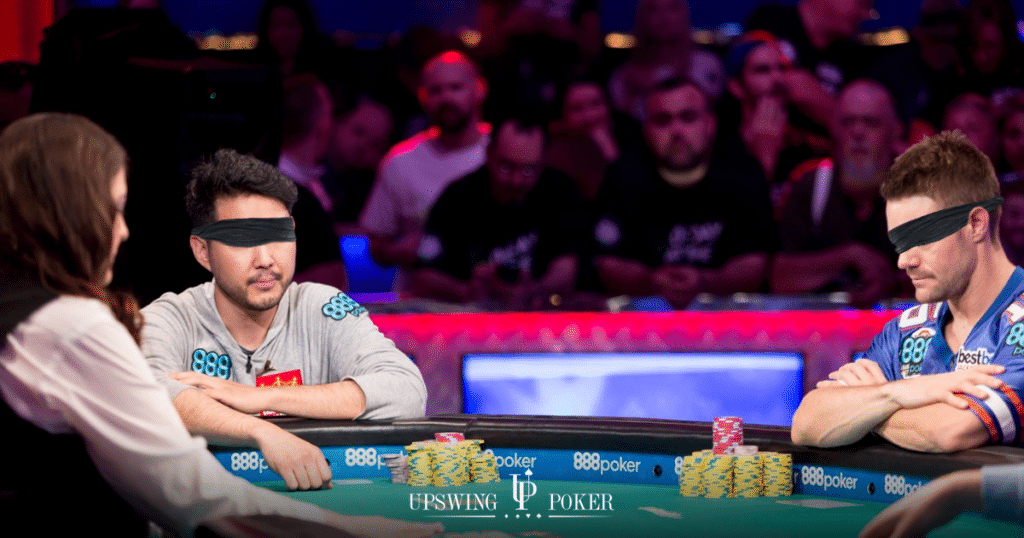
Should you fold, call or shove? To simplify the example, let’s assume telling is not an option (since you are short-stacked, it’s not attention anyway). To answer this, we need to assign a calling range to the big blind. Based on our read, it is fair to assume they would call with pocket pairs of 77+ and A7+. This comprises about 12% of all possible hand combinations. So we need to know how well we fare against his range if we get called. To calculate this, we’ll use the Stove:
31.275%
68.725% { 77+, A7s+, A7o+ }
We are behind, but our opponent is only calling with about 12% of all hands. This means that the BB folds 88% of the time. If we get called and win, our stack will double to $4,000, and of course, we’ll be we’ll we lose.
Based on these calculations, here are all the possible outcomes:
- We fold: after posting the SB, our stack is now 1,850.
- We shove, BB folds: stack is 2,300 x 88% likelihood = $2024 expectation.
- We push, BB calls, we win (12% calling X 31.275% winning = Occurs 3.753%): 4,000 x 3.753% = $150.12 expectation.
- We shove, BB calls, we lose (12% calling x 68.725% = Occurs 8.247%): $0 expectation.
If you add up all the possible outcomes for shoving, you get $2024 + $150.12 + $0 = $2174.12.
+2174.12: Total expectation of shoving
– 1850.00: Total expectation of folding
$324.12: Total expectation
You can see that you gain an average of +$324.12 EV in the long run if you push it all in. But we just used a hand that was statistically better than an average hand the BB could hold. What if we went all in with a trash hand, like 72os?
24.931%
75.069% { 77+, A7s+, A7o+ }
- We shove, BB folds: our stack is 2,300 x 88% = $2024 expectation.
- We shove, BB calls, we win (12% calling X 24.931% winning = Occurs 2.99%): 4,000 x 2.99% = $119.60 expectation.
- We shove, BB calls, we lose (12% calling x 75.069% = Occurs 9.01%): $0 Expectation.
+2143.60: Total expectation of shoving (2024 + 119.60)
– 1850.00: Total expectation of folding
$293.60: Total expectation
So because our opponent is only calling with 12% of hands, our shove with the worst poker hand is still highly profitable. You can play with Poker Stove and change your opponent’s opponent’s calling range to determine different expectations.
Hand Example – Hero Call on the River
This final example is also from a no-limit hold ’em tournament, but this time we’re going, we’re looking at the play post-flop.
From the button, you raised pre-flop to 500, and the big blind defended. On a flop of your opponent’s, you bet 850 into a pot of 1350:
The big blind (player 7) has shown to be a loose player capable of calling people down with marginal hands and chasing draws. He has also played his bigger hands strongly.
Your opponent calls your 850 bets. Now let’s look let’s and the ranges. Since your opponent is loose and likes to see the flop, his defending range pre-flop is pretty wide. Since he would most likely re-raise with AQ+ and 88+, I would assign a range of A2-AJ, K9+, Q9+, 22-77, all connectors, and one-gappers 56 – JT. We can narrow down his field since he has called our continuation bet. Based on our read of him playing bigger hands strong, we can eliminate AT, AJ, 66, 77, 67, A6, and A7. Removing all other writings that did not connect with this flop, we are down to A2-A5, A8, A9, 89, 56, 57, 97, 87, 86, and all flush draw combos. It’s possiIt’she may have check-raised with a strong draw, but our read on this player is that he usually calls in these situations.
The Turn & River
The turn card brings a . Based on our read, this won’t chan unless our opponent turns two-pair with A2 or hits a set of 2’s. Our o2’snent checks, and we check behind for pot control. The river is, and our opponent shoves all-in for 3,625:
The pot is now 3,050, and our stack is also 3,625. The King is a tricky card because we are losing to any Ace and any suited King chasing a draw, but we are way ahead if our opponent was on an interest or had middle pair. Our opponent could have two-pair or a set, but based on our original read of his range, this isn’t like it isn’t; however, we cannot rule it out completely. So let’s booklet her EV of the situation.
Pot Odds: 3050 in the pot + 3625 in his stack = 6675, and it’s 3625. This is 6675/3625 or 1.83 to 1. So we cannot be behind more than 1.84-1 to make this call profitable.

53.125%
46.875% { 55-22, A9s-A8s, A5s-A2s, KsQs, KsJs, KsTs, Ks9s, QsJs, QsTs, Qs9s, JsTs, Js9s, Ts9s, Ts8s, 9s8s, 9s7s, 8s7s, 8s6s, 75s, 65s, A9o-A8o, A5o-A2o, 97o+, 86o+, 75o, 65o }
Using Poker Stove, you can see that we are slightly ahead by 1.13 to 1. Based on pot odds, this would be a +EV call. But sometimes, we need more confidence in iffy situations. Let’s see what Let’sour actual expected value is.
To calculate our expected value, here are all the possible outcomes:
- We fold: Stack is 3,625
- We call and win (53.125% of time) = 10,300 x 53.125% = $5471.87 expectation
- We call and lose (46.875% of the time): $0 Expectation
+5,471.87: Total expectation of calling
– 3,625.00: Total expectation of folding
$1,846.87: Total expectation
As you can see, by making this call, you will win an average of $1,846.87 over time, giving it a high positive expectation.
Conclusion
The best way to train yourself to make +EV plays consistently is to analyze key hands after each play session. This will allow you to assign hand ranges with a clear head and make an unemotional assessment of whether a space had positive or negative expectations. The more you train yourself to become analytical with these decisions, the more profit you will make at the poker tables.


