

Cracking the Code: Understanding Flop Texture in Texas Hold’em
Far too many players ignore flop texture when playing Texas Hold ’em. Why so many players miss texture continues to amaze me. After all, a flop’s texture is free information when trying to connect the dots by evaluating the board’s composition and the range of cards your opponent could hold. While it’s easy to assign a range of hands to your opponent abstractly, the texture of the flop goes a long way toward delineating the scope of indicators, he is likely holding, along with those potential hands that might have been dashed by a texture that won’t help his hole cards at all.
Poker players who bet and call without regard to texture are making a costly mistake, and these are the very players you want to play against. When you consider board texture and assign a more precise hand range to an opponent because the board’s surface has modified his broader range, your reads on your opponents will be all the more accurate.
Dry and Wet Boards
The first thing that should come to mind when considering flop texture is whether you’re looking at a dry or a wet board. While further refinements can be made when examining boards, step one determines whether the board is dry or wet. Dry boards offer few drawing possibilities, while wet boards are rife with withdrawing options. Boards in between are neutral.
Dry boards generally have one big and two small cards or three small cards that do not support a flush draw, and while a ragged board might keep a straight interest, it’s unlikely that your opponents would be holding cards that connect with such a flop.
Examples of Dry Boards

Look at those flops. There aren’t many hands that coordinate with them. While someone holding would love the first flop, and an opponent in his hand would have flopped a set with the latter board, you can’t assume your opponent has either of those hands. You have to begin assessing your opponent’s hand by assigning a range of indicators to him, and when you do, the fields supported by these two flops are quite narrow.
Playing Into a Dry Board
When examining a ragged, low flop, it’s important to consider whether anyone raised before it. If there was a raise before the loss and callers – especially cold callers as opposed to players who called and then called again when the pot was raised behind them – there’s a far less likelihood that a low, ragged board was the answer to anyone’s prayers.
If the raiser was in early position, and most or all of your opponents cold-called the raise, you can discount the possibility of a straight anytime you see a dry, low, ragged board, and anyone who comes out betting is either representing an overpair or bluffing.
A dry board can also contain a pair, and a flop-like is dry because it does not support any draws. That doesn’t guarantee a win for you. After all, someone might have taken a flyer with a hand and is now sitting pretty with a hand no one suspects him of holding. Even if someone hung around with them, he’s probably in the lead with two pairs, even with a dicey kicker.
Wet Boards
Wet boards are the opposite of dry boards; they’re heavy with draws and well coordinated. Here are a couple of examples of wet boards:

These two flops have two big cards that would pair up with the kinds of big cards most hold’em players are fond of. They support flush draws, along with a couple of straight draws. If these flops hit someone perfectly, that person already made his straight.
The more coordinated a wet board is in supporting straight and flush draws and the greater the number of players in the pot, the more a wet board makes it difficult to envision winning with a hand like a top pair or top kicker.
Boards like this have cards that reside in what’s referred to as the playing zone. The playing zone is just what you think it is: the deck area where players find cards they want to play, usually cards ranging from jack through ace or ten through authority. When most players are dealt two cards in the playing zone, they will look for a reason to play them, and only a big raise, or a raise and a raise, will dissuade them.
Board Texture and Continuation Bets
Reading the board’s texture is crucial when considering whether to make a continuation bet. It’s not difficult at all to do this. If the flop hits you hard, you will bet; that’s a given. But the flop figures to miss you more often than not. If, for example, you raised before the flop with A-K, you will only like the flop one-third of the time. But by evaluating the board’s texture and the range of your opponent’s likely cards, you’ll have a good handle on whether you should bet when you miss the flop.
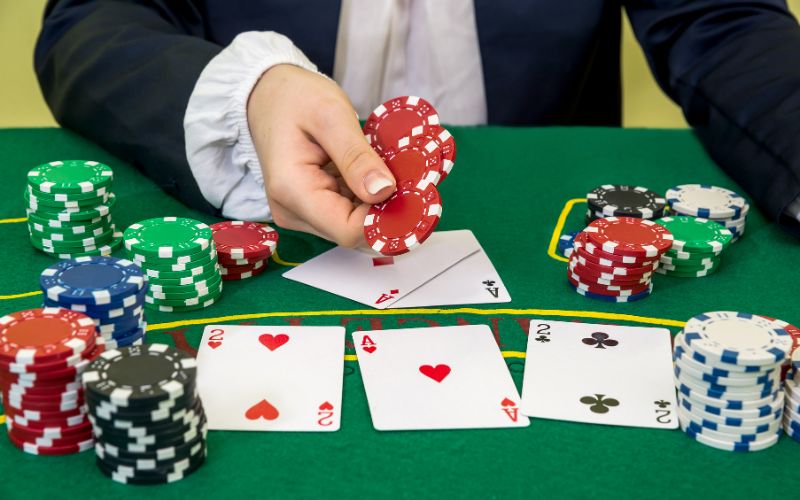
Dry boards garner more folds than wet boards because there are fewer combinations of hands to connect with them. When you’re the pre-flop raiser and know that the flop is unlikely to have helped your adversary, you can make a continuation bet knowing you have a good chance of forcing your opponent to fold. Even if he thinks you might not have connected with the flop, there’s always a chance that you’re sitting there with a big pocket pair. On the other hand, you know he had nothing before the flop and probably nothing on it.
So go ahead and c-bet into that dry board and watch your opponent fold most of the time. If your opponent plays hit-to-win, fit-or-fold poker, you’ll take down the pot almost every time. Just remember not to vary your bet size too much when c-betting compared to when you have a real hand, so your opponent can’t gauge the strength of your hand by the size of your bet.
Using Texture to Raise Aggressive Opponents
Sometimes, you can raise an aggressive opponent on the flop based on your drawing possibilities and the board’s texture. Suppose there was a raise before the loss, and you call from a late position with a hand. We’ll assume both are blindfolded, and the loss is. The flop’s texture does not support a flush draw, so you need not worry about that. And while you don’t have a hand yet, you have a straight interest and two overcards that might propel you into the winner’s circle if you pair on the turn or the river. You’ve got lots of ways to win.
Your opponent is probably raised in front of you with a pocket pair or two big connecting cards. Based on probability alone, chances are your opponent has big cards rather than a team, and if he does, he whiffed on the flop. If he has A-K, A-Q, A-J, K-Q, or a medium couple like 7-7 or 8-8 and comes out betting, he might even fold to your raise, and you won’t have to see the turn or river to win the hand. The flop’s texture, coupled with the equity in that combination of a big draw plus overcards and the likelihood that your opponent didn’t like the loss, gives you a good chance of taking it down with a raise.

On the other hand, suppose you were raised only to see a flop. Even if the blinds check to the raiser, you’re staring straight up at two overcards right in the playing zone. You have no draw to speak of and are probably going to check, hoping that anyone who acts after you will also check so you can see a free card in hopes of turning a set.
Now we’ll assume you open-raised with from a late position only to see a flop. A low-card defeat tends to hit callers rather than raisers, so a continuation bet is probably the way to go here because the failure probably missed your opponents just as it missed you. But if you make a bet and are called, figure out your opponent for a pocket pair or a draw since these are the very kinds of hands that would call in this situation. When that happens, you’ll have to be wary of any turn card that appears to support hands of that nature.
If the turn card is big – an ace or a king – it will appear scary to anyone on a draw or holding a small pair, giving you a good opportunity to stab at the pot. But if the turn is a low card, you’re better off checking and probably souping your hand if your opponent bets.
Awareness of the flop’s texture and the board’s surface on the turn and the river is a powerful tool for assessing the possible strength of your opponent’s hand. Texture, along with betting patterns, the number of players contesting the pot, and their playing styles, goes a long way to raising your game far above that of a simple hit-to-win strategy and gives you several ways to identify opportunities to bluff, bet on the come, or check and fold. Each can win or save money for you in the long run.
Related Lessons


