

Poker’s Hidden Weapon: How to Exploit Stack Sizes
In no-limit hold ’em, your stack size and your opponent’s stack size greatly influence your strategy. If your opponent has a small stack relative to yours, it can lead to more aggressive play, like going all-in. However, when both you and your opponent have substantial stacks, caution is advisable, even with a strong hand. The larger the stacks, the more important it becomes to protect your chips and fold when necessary to avoid risking your entire stack.
How to Use Stack Sizes to Your Advantage in Poker

Poker strategy revolves around stack sizes, both yours and your opponents’. Here’s how to make the most of them:
Assess Your Stack
- Short Stack (Less than 10-15 big blinds): Look for opportunities to double up.
- Medium Stack (15-30 big blinds): Play cautiously, choosing hands wisely.
- Big Stack (30+ big blinds): Be more aggressive and apply pressure.
Exploit Short Stacks
Target short stacks by raising their blinds or calling their all-ins cautiously.
Pay Attention to Opponents’ Stacks
- Target other short stacks for steals.
- Be cautious against bigger stacks, avoiding big pots unless you have strong hands.
Consider ICM
- In tournaments, understand ICM to make better decisions based on the prize structure.
Adjust Bet Sizes
- Match your bets to pot size and effective value extraction or stack protection stacks.
Be Aware of Bubbles
- Pressure short stacks as tournaments approach the bubble.
Adapt to Change
- Stay flexible as stack sizes evolve, especially in multi-table tournaments.
Mastering stack sizes will give you a significant edge in poker, enhancing your strategic prowess and improving your chances of success at the table.
Putting All Your Chips at Risk

You will find some opponents who will go all-in regardless of the cost with a big pocket pair, particularly pocket aces, and that’s a major leak in their game. Big and pretty as they are, aces are only one pair, and if his opponent flops two couples or a set, he’s looking to take every chip from the guy willing to go to his grave with aces.
While you’re not going to crack an opponent’s pocket rockets all that often, you don’t have to. If you have an opponent willing to play top pair or an overpair for all his chips, all you need to do is have this confrontation once a day to ensure a healthy return on your investment at the poker table.
Many poker players make it a point never to go broke with one pair, except when they are short-stacked in a tournament and must make a stand to double up or go home. But under normal circumstances, many of your opponents will not put themselves in a position where they have to confront the possibility of going broke with a single pair—even if it’s aces.
But some players are willing to put all their chips at risk with one pair. Players who were reared on fixed-limit hold’em seem to suffer from this problem. To limit hold’em players, pocket aces are generally a through-ticket to the river, barring some odd board like four of a single suit that doesn’t match yours or a four-straight on board with a bet and a raise before the action gets around. But those are rare birds and limit hold’em players generally play a pocket pair of aces fast and strong regardless of the board.
This affliction also bedevils very tight players too. They play so snugly that when they finally pick up a premium hand, they are unwilling to release it since they regularly fold so many other indicators. These players are often smart enough to understand they can be in trouble with one pair—even when that pair is aces—but are often emotionally unwilling to release the kind of hand their tight, rocky play has been waiting for all session.
Playing Through Multiple Streets
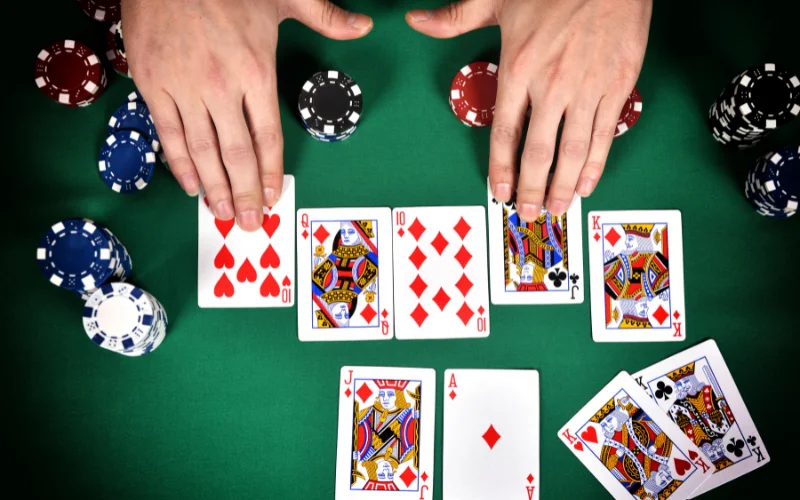
One of the expensive lessons learned when taking up no-limit poker is that decisions made on one betting round impact those made subsequently. In a fixed-limit game, a bet on the flop or the turn is independent of what might transpire on subsequent rounds. Sure, your opponent might bet the turn if he bet the loss, but the amount of his bet is a known quantity and can easily be factored into a play-or-fold decision on that earlier betting round.
But whenever an opponent bets or raises on the flop or the turn in a no-limit game, there’s a good chance he will make an even bigger wager on the next betting round. When all your chips might be at risk on subsequent betting rounds, consider the potential cost of impending bets when deciding to call now.
This has the effect of implied odds being leveraged against you. A call made at the price of a few chips when you have a drawing hand must be made with a considered awareness of what you intend to do if you miss your draw on the current wagering round and your opponent subsequently fires a very big bet at you. If that happens, the cost to take a card off and see the river will have gone up dramatically, and the odds against completing your hand with only one card to come—as compared with the odds against making your hand with two cards to come when you’ve just seen the flop—have just gotten significantly longer.
The Short Stack Specialists

Many poker players – particularly those who play online – actively seek out no-limit games where they can buy in for a short stack. They employ tactics designed to double up whenever possible while minimizing big losses, specifically because they do not play a big enough pile to put their bankrolls at risk.
A short-stacker might look to buy into a cash game from between 15 and 30 big blinds. That’s a big difference from the maximum buy-in, ranging from 100 big blinds to an unlimited amount. Because of the difference in stack sizes, short-stacked and deep-stacked players play different games for different stakes at the same table. Whenever two deep-stacked, and one short-stacked player contest a pot, the side pot is likely to be much larger than the main pot.
Because a short-stacked player has little leverage over the actions of his more deeply stacked opponents, he has to play tight poker. In contrast, the deep-stacked players can employ a looser style, using their stack size to pressure other players while manipulating the pot odds offered to them.
A tight but aggressive short-stack strategy works best with a minimum of seven others at the table. If the table is short-handed, a short-stacked specialist will be hard-pressed to keep up with the cost of the blinds paid while waiting for big, playable hands. In addition, the short stack strategy works better against loose opponents. Our short-stacked specialist is looking for opportunities to go all-in for his quick buy-in and hoping for two or more callers when he does.
Conclusion
Determining the effective stack size is critically important in every hand you play. Without an awareness of how much potential risk exists based on the stack sizes, a player can easily get into more trouble than he’s looking for. It’s been said that poker is a game of money played with cards, and without being aware of stack size and the amount of money at risk on any given hand, a player can be in grave danger and not even realize it.


