
Starting Hand Selection in Texas Hold’em: Unlocking Victory!
One of Hold’em’s most crucial decisions is, do I see the flop, or don’t I see the failure? In this lesson, we’ll examine the importance of starting hand selection and what factors you need to consider before deciding whether to hold ’em or fold’em.
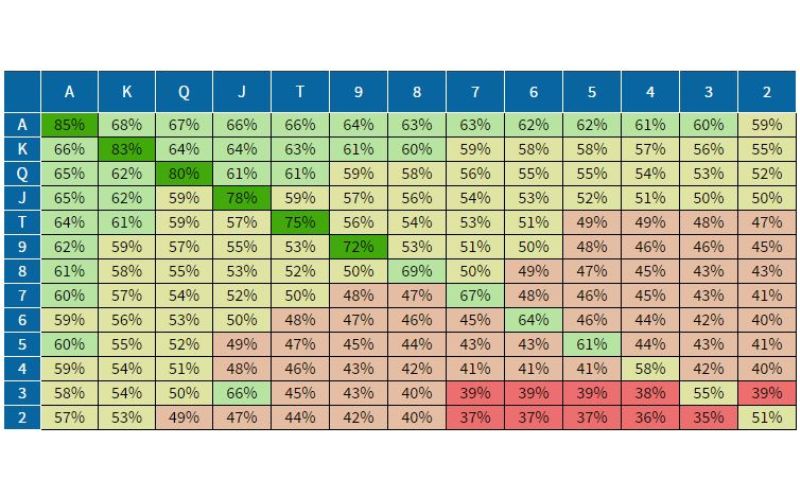
There are 169 different two-card starting hand combinations in hold’em poker. For the sake of argument, this number assumes that it is the same as any other suited combination. If you are not dealt a pair, your starting hand will either be done, unsuited, connected, or unconnected (gapped). This means your starting hand will fall into one of the following five categories:
- Pairs – e.g.,


- Suited connectors – e.g.,


- Connecting cards – e.g.,


- Suited unconnected cards – e.g.,


- Loose cards – e.g.,


Unconnected cards might be one, two, three-gapped, or more. The bigger the gap, the less chance you have of hitting a straight. For example, if you hold 73, you’d need a flop of 456 for the serial. But holding T8, you could flop a straight with 9JQ or 679.
The Best Starting Hands in Hold’em
Let’s start by discussing the best-starting hands, often called ‘premium hands.’ There is some disagreement among poker players as to which starting hands are the best, but few would dispute the value of the first of our three main groups, Aces and Kings.
Group 1: AA, KK

These two starting hands are the major players in Hold’em. It’s not often you’ll get dealt Aces or Kings. You get either Aces or Kings once in every 110 hands, so it’s not nearly as often as we’d like. Aces are the best possible starting hand in hold’em, closely followed by Kings. However, you should know that even Aces or Kings can get cracked, and they don’t play well against multiple opponents. This means you should be raising pre-flop to narrow the field. Extra caution is necessary when playing Kings because if an Ace falls on the flop, you lose to anyone with a single Ace in their starting hand. While they are very strong hands which most players love to get, they are certainly not unbeatable.
Group 2: QQ, JJ, AKs

Queens and Jacks are great starting hands; with either of these, you can usually be confident you have the best-starting hand. Of course, they are dominated by Aces and Kings, but they’re a favorite against all other starting hands. While Queens and Jacks occasionally run into a player holding either Aces or Kings, it doesn’t happen too often. Play these cards strongly, and always look to raise with them.
Ace-King is known throughout the poker world as Big Slick, and when suited, it’s often called Super Slick. While it isn’t a ‘made hand,’ it offers great potential, unlike a pair. It’s only a big underdog to Aces and Kings, and even pairs like Queens and Jacks are only slight favorites. The beauty of AK (suited or unsuited) is that it dominates many other hands like AQ, AJ, AT, etc. Players usually push all in with these types of hands late in a tournament.
Group 3: TT, AK, AQs, AJs, KQs

This next group of starting hands is also a strong bunch. It would be best if you were looking to raise pre-flop with any of these hands too. We’ve already talked about the power of AK, but starting hands like AQs, and AJs, are also very strong and often run into weaker Ace-X combinations. Even though these are all strong starting hands, and most of the time you’ll be winning pre-flop, you must be careful – particularly a hand like KQs, which you can easily fold to a re-raise.
Suited Cards
You’ll often hear novice players responding to the questioning why they played a particular starting hand with the line “Well, because they were suited.” Some suited cards are worth playing, and it’s certainly better to start with suited cards than unsuited cards. However, the odds of flopping a flush is 1 out of 118 hands (0.8%) with two appropriate cards, and you’ll only make a flush after the river around 6.5% of the time. Don’t fall into the trap of playing any two cards just because they happen to be suited – it doesn’t make a big enough difference to make junk hands valuable.
Kicker Issues
The word ‘kicker’ means the smaller of your two cards. Some players play a hand if it contains an Ace with any other card (such as an Ace with a three kicker), and this type of play ultimately costs players money and tournaments. For example, suppose a player calls with A6, and the flop comes with A83. What does the player do? Bet? Call? Raise? Name a big raise. Go all-in? What if the loss comes to Q63? The player has middle pair – which is very hard to play. The loss could come A6X – the player has two teams, Aces and Sixes, but this happens only in 1 out of 49 hands (2%). Until you learn when and how to play Ace Junk (AX), go slow with it. One good thing about A junk and K junk is that you do not need to play these hands to learn when they may be profitable. Let experience from other hands and study be your teacher.
Table Conditions
Holding them starting hands can be complex because every situation is different. If you were to ask a professional poker player, “Should I call, raise, or fold this hand pre-flop?” his response would almost certainly be, “It depends!” Here are some of the main reasons why it depends:
The Number of Players
The value of certain starting hands depends on the number of players at the table. Certain starting hands will always be threatened against a table of nine or ten players, but the value of these hands increases when there are fewer players. A starting hand like KJ might be vulnerable against a full table of players but is considered a strong hand if there are just a few other players.
Position
Your position on the poker table will majorly factor in deciding which starting hands you should play. The later your work in the betting order, the better – you get to decide what to do after most of your opponents have acted. We’ll talk much more about the importance of position throughout our lessons on Pokerology, but as a first step, please see our lesson on the value of a job. Playing position can elude us at first because it is a part of poker that lends itself to being exploited through experience. However, you must quickly realize that your position at the table should heavily influence the choice of starting hands you play. Until a player has a feel or grasp for positional play, believe and follow some suggestions.
A Raised Pot
Whether or not a pot has been raised should be an important factor in your decision to play a particular starting hand. Your starting hand selection should change when a reasonable player has submitted the pot. If there has been a raise and a re-raise before you’re due to act, then you should only consider playing with a very strong hand. Of course, this will also depend on the personality types of the other players and whether the game is very loose or passive.
Starting Hand Charts
 When you first start playing poker, using a starting hand chart as a reference point can be helpful. We’ve created a couple of beginning hand charts that beginners can use. Please click on the following links to view these charts (they will open in a new window):
Each of these charts loads as a PDF, meaning they are viewed on screen, bookmarked, or, better still, can be printed and studied offline.
Beginners can treat starting hand charts as the gospel. Still, once you know enough about the game to recognize appropriate opportunities, you can deviate because your adjustment may represent a more profitable play. Our starting hand charts are a guide, not a set of intractable rules. There is no such thing as a perfect starting hand chart because every game is different, and there are many variables at work. Game texture and table conditions can’t be measured and included in a neat formula.
Many factors may encourage you to tighten or loosen your play from our guidelines. If you have a starting hand not listed on the chart, then there’s a good reason – it should almost always be mucked. But as in all poker decisions, “It depends” comes to mind. However, before you deviate from our guidelines, have a reason for taking such an action.
Conclusion
Don’t fall into the trap of playing any two cards. Most poker players want to play hands, and as a beginner, it’s very easy to be seduced by suited cards or picture cards, or any two-card holding that contains an Ace of a King – but if you play hold’em correctly, you’re going to be selective and toss away the vast majority of hands you’re dealt.
When you gain more poker-playing experience, you can open up your range of starting hands – but until then, proceed with caution and only play the best hands. Loose, promiscuous play will get you into trouble and is the downfall of many players.
In future lessons, we’ll expand on the topics discussed in this poker lesson and get you to think beyond the cards you’re dealt. We also have hours of video footage covering starting hand selection for both no-limit and fixed-limit hold’em – so depending upon your preference, be sure to check them out!


