

Dealing with Tricky Poker Players
There are many types of poker players. Most are relatively easy for the good player to read. They tend to play hands within a certain range in certain situations. They tend to be aggressive, passive, tight, loose, or a combination of those traits. Using your knowledge of them and how a particular hand has been played, you can generally put them accurately on a relatively small range of indicators. Once you put them on that range of hands, the good poker player can exploit them – folding, raising, checking, or calling as the situation calls for.
Exploiting Bad Poker Players
Such is not universally true, however. Some players are so bad at poker that putting them on a hand is nearly impossible. How can you figure out what they are playing if they don’t understand even the basics of what they are doing? Exploiting those bad poker players is not a function of figuring out what they have but of playing your good hands strongly – expecting them to have weaker hands most of the time. You win their money because of their mistakes – and there will be many.
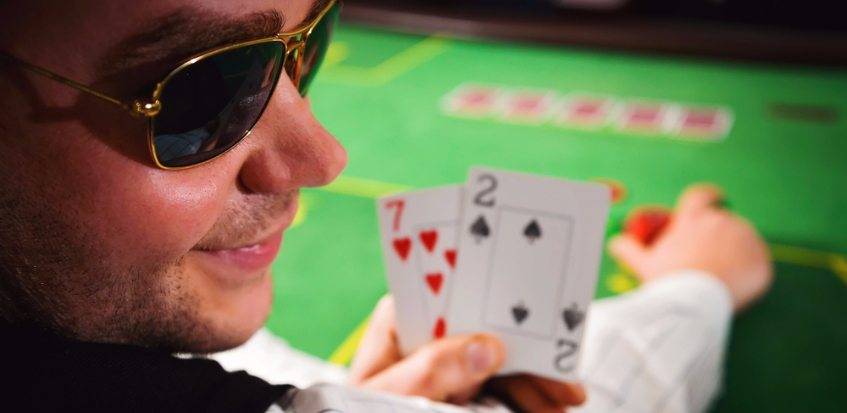
Understanding Tricky Poker Players
This article is not about that, however. It’s about the second category of player who is very tough to put on a hand: the tricky poker player.
Tricky poker players deliberately mix up their play – not consistently playing the same hand in the same situation the same way. A tough poker player may deliberately slowplay Aces from a middle position once and then play them very fast the next. He may go all in with 63off if he feels the situation is right. He may call with Jacks on the button when everyone folds to him, and then, the next time he has Jacks, he may fold them to a raise. He’s tough to read.
Challenges and Strategies
Many players work hard to read these tricky players – trying to spot a tell or detect some betting pattern. Among the best of us, we may glean some way, clues, and poker tells to help us figure out these tricky players. It’s not necessarily impossible, just very difficult. Given sufficient poker skills and powers of observation, you might be able to figure them out – discern when they are acting and when they are playing straightforwardly. And, surely, at the highest levels, that is exactly what the expert poker player needs to do to get the best of the game.

But for the rest of us, I suggest you not spend much time and energy figuring out the tricky player. I will say the opposite: you do not focus on whether the tough player is really strong or only pretending to be strong.
Profiting from Weak Players
Most of your profit will come from the other poker players – the weak and straightforward players. They are the ones you will be able to figure out – or who will be so bad that you will make money from them without being able to figure them out. I suggest you adopt one of two simple strategies. Neither of these strategies requires that you figure them out.
Evading Tricky Players for Long-Term Success
The first strategy is simple. It is avoidance. You will attempt to avoid playing against them. If they raise, you fold unless you hold a super-premium hand. If you submit and they re-raise you, you do the same thing – fold and live to fight another day. If they seem to be targeting you because they perceive that against them, you are weak tight and thus easily exploited by them, then you will leave the game and find greener pastures elsewhere. It bothers the ego to bow out from a fight like this. But from my experience, discretion is the better part of valor in such a situation. Save your bullets for opponents who move more slowly and are more predictable. Your bankroll, if not your ego, will thank you in the long run.
Anti-Spin Poker Strategy
But avoidance isn’t always possible. Sometimes you are too invested in a hand to fold. Sometimes you have a very strong holding but not the nuts. Not every situation is clear-cut enough for you to bow out. In those circumstances, I suggest you take a page from my old ping-pong strategy book. I recommend you use some “anti-spin.”
In the parlance of ping pong (more properly called “table tennis” at the competitive level where this comes into play), a type of rubber neutralizes the intense spin players can impart on the ball. This type of rubber doesn’t impart much of its spin and isn’t very good on offense. But that’s just the point. Because it is not very tacky, it helps absorb the opponent’s spin and enables a defensive return that keeps the ball in play. In a word, it is “non-reactive.” Against players with the most powerful spins, anti-spin rubber is a critical ingredient in preserving the point.
Conclusion
In poker, “anti-spin” is useful against tricky opponents as well. It is a strategy that, as much as possible, takes the guesswork out of your play. You play as passively as you can – checking rather than betting and calling rather than raising. This isn’t to say that you will avoid any difficult decisions. You won’t (which is why I first suggested the avoidance strategy). But your neutral style will tend to deaden the trickiness of your opponent – as you play defensively rather than offensively.
Related Articles
-
- Poker Battles: It’s Nothing Personal
- Poker Warfare: Underestimating Opponents
- Poker and the Flight Club – Conflict Avoidance
- Poker Brains vs. Poker Balls


