

Master the Game with Math and Probability Poker Lessons
The main underpinning of poker is math. Psychology plays a part, but a solid understanding of probability will serve you well at poker. Read more
Understanding Expected Value
Expected value is a very important concept in poker. You’ll be profitable in the long run when you make decisions with a positive expected value.
Expected value is a concept used in probability theory and statistics to measure the average outcome of a random event over the long run. It is a way to quantify the “expected” or average value of an uncertain outcome, considering the probabilities associated with different possible outcomes.
To understand the expected value, consider a simple example of rolling a fair six-sided die. Each face of the die has an equal probability of 1/6 of appearing. We can assign values to each outcome, such as winning or losing money. Let’s say we win $10 if a 6 appears and lose $2 for any other outcome.

Calculate the expected value
To calculate the expected value, we multiply each outcome by its corresponding probability and sum them up. In this case, the calculations would be as follows:
Expected value = (Probability of rolling a 6) * (Value of winning $10) + (Probability of any other outcome) * (Value of losing $2) = (1/6) * $10 + (5/6) * (-$2) = $10/6 – $10/6 = $0
The expected value, in this case, is $0, which means that, on average, you neither win nor lose money in the long run. This result makes sense because the game is fair, and the expected value reflects that fairness.
Poker Drawing Odds & Outs
In this lesson, we focus on drawing odds in poker and how to calculate your chances of hitting a winning hand using basic math and several shortcuts. Read more
In poker, drawing odds and outs are crucial concepts players use to evaluate the probability of improving their hands. Understanding these concepts helps players decide whether to continue betting, calling, or folding in a particular hand.
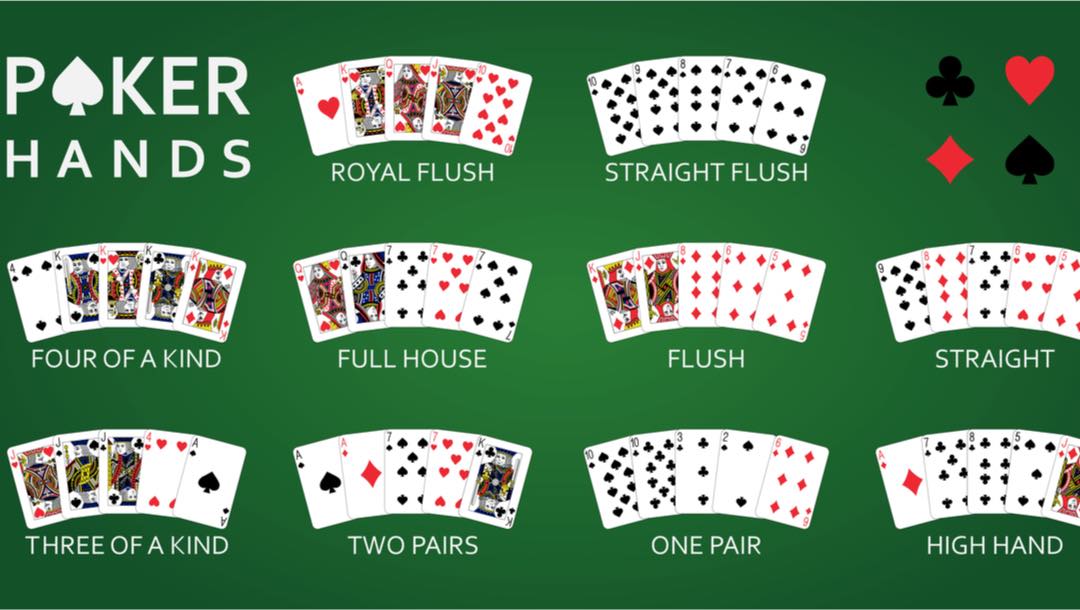
Outs
In poker, outs refer to the number of cards remaining in the deck that can improve a player’s hand to a winning one. For example, if a player has four cards to a flush (four of the same suit), there are nine remaining cards of that suit in the deck (assuming a standard 52-card deck), so the player has nine outs to complete the flush.
Drawing Odds
Drawing odds, also known as pot odds, represent the ratio between the potential winnings and the cost of a particular bet. It helps determine whether it is mathematically profitable to continue playing a hand. Drawing odds are typically expressed as a ratio or a percentage.
To calculate drawing odds, you compare the number of outs you have with the number of cards remaining in the deck.
The formula for calculating the drawing odds is as follows:
Drawing odds = (Number of outs) / (Number of unseen cards)
For example, if you have nine outs to complete a flush and there are 47 unseen cards (52 cards in the deck minus your two hole cards and the four community cards), the drawing odds would be:
Drawing odds = 9 / 47 ≈ 0.1915 or 19.15%
This means you have approximately a 19.15% chance of hitting your flush on the next card.
Using Drawing Odds: Once you have calculated the drawing odds, you can compare them to the pot odds to determine if it’s profitable to continue playing. Pot odds represent the ratio of the current size of the pot to the cost of your bet.
Poker and Pot Odds
Pot odds mean there is enough in the pot to call a bet. Knowing pot odds lets us concentrate on the other players and turns poker into a … Read more.
Calculate pot odds
To calculate pot odds, you compare the current size of the pot to the cost of your bet or call. Pot odds are typically expressed as a ratio or a percentage. Here’s the formula for calculating pot odds:
Pot odds = (Pot size) / (Cost of bet or call)
For example, if the pot size is $100 and the cost of your bet or call is $20, the pot odds would be:
Pot odds = $100 / $20 = 5
Pot odds of 5 means that for every $1 you bet, you stand to win $5 from the pot if you win the hand.
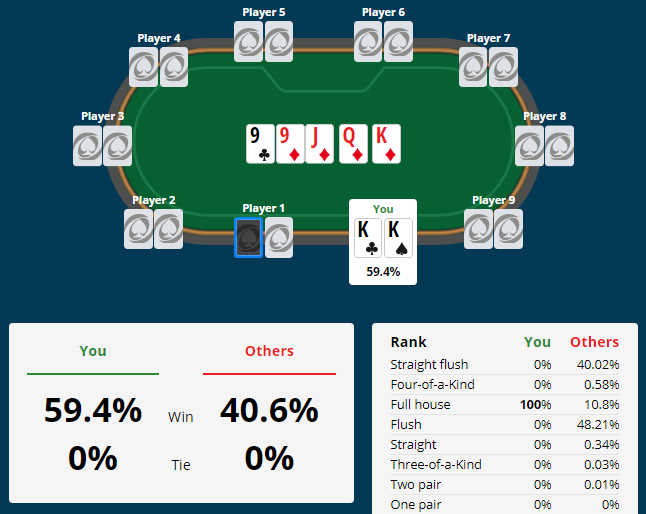
Using Pot Odds
Once you have calculated the pot odds, compare them to the odds of completing your hand. The odds of meeting your hand are determined by the number of outs you have (cards that can improve your hand) and the number of unseen cards (remaining cards in the deck).
For example, let’s say you have four cards to a flush and nine unseen cards of that suit. The odds of completing your flush can be calculated as follows:
Odds of completing the flush = (Number of outs) / (Number of unseen cards)
Variance in Poker
The ups and downs of poker are often collectively known as variance. But what is it, and how is it calculated? And how can poker players deal with … Read more
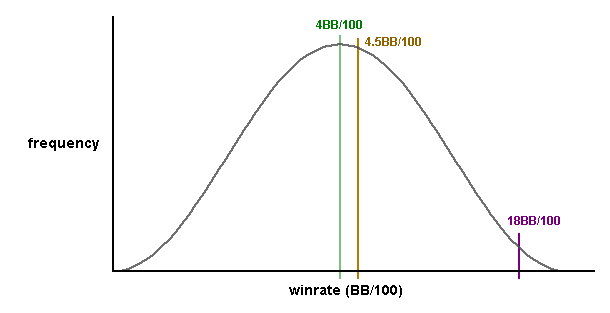
Factors that Contribute to Variance
Probability and randomness
Poker is a game of incomplete information, where players make decisions based on incomplete knowledge about their opponents’ hands. The random distribution of cards introduces an inherent element of uncertainty and variability in the outcomes of hands.
Short-term luck
In a single session or a few hands, luck can significantly impact results. Variance can lead to stretches of good fortune, where players experience a series of favorable hands, and periods of bad luck, where they face a run of unfavorable indicators.
Player dynamics
The style and skill levels of opponents also contribute to variance. Players with erratic or unconventional strategies can introduce additional uncertainty, making outcomes less predictable.
Game format
Variance can vary across different poker variants and formats. High-variance games like No-Limit Texas Hold’em tend to produce more significant swings due to the increased betting options and potential for big pots.
Calculating Expected Value
In this poker lesson, we take your understanding of expected value to another level and discuss the primary criteria for thinking about expected value. Read more
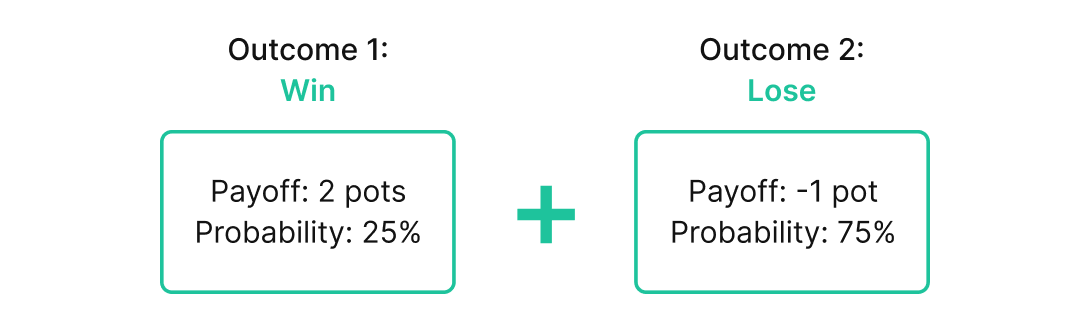
The formula for calculating the expected value is as follows:
Expected Value = (Outcome 1 * Probability 1) + (Outcome 2 * Probability 2) + (Outcome n * Probability n)
To calculate the expected value, you multiply each possible outcome by its corresponding probability and then sum up these values.
Here’s an example to illustrate how to calculate the expected value:
Let’s consider a simple scenario of flipping a fair coin. Two possible outcomes are getting heads (H) or tails (T). The probability of each outcome is 0.5 (assuming the coin is unbiased).
Suppose you win $10 if the coin lands on heads and lose $5 if it lands on tails.
Expected Value = ($10 * 0.5) + (-$5 * 0.5) = $5 – $2.5 = $2.
PokerStove Tutorial
PokerStove is a handy poker odds calculator used to examine hand matchups and equity calculations. Read or watch our tutorial to learn how it works. Read more

Input Hand Ranges
-
- Launch PokerStove, and you will be presented with the main interface.
- In the “Hand” section, enter the starting hand ranges for each player. You can input specific hands or use hand range notations (e.g., AA, AKs, 88+).
- Specify the number of players in the hand.
Adjust Parameters
-
- PokerStove allows you to adjust additional parameters to refine your analysis.
- The “Board” section allows you to specify community cards. This is particularly useful for evaluating post-flop situations.
- You can also adjust parameters like dead cards (cards you know are not in play) and the number of iterations for more accurate calculations.
Analyze Scenarios
-
- PokerStove provides various features to analyze different poker scenarios.
- You can compare hand ranges against each other to determine the best-starting hand or evaluate the strength of your hand against specific opponents.
- Use the “Hand Query” section to input specific hands and evaluate their equity against ranges.
Calculate Expected Value (EV)
-
- PokerStove allows you to calculate the expected value (EV) of different actions or betting decisions.
- You can estimate the profitability of different moves by comparing the equity percentages of different hands and factoring in the potential payouts.
Heads-up Matchups in Hold’em
This list of common heads-up matchups in hold’em focuses on various pre-flop situations, and we provide statistical odds. While these statistics don’t have to be… Read more
Hand Selection
-
- Starting hand requirements typically loosen up in heads-up play compared to full-ring games. Since you are playing against only one opponent, a wider range of hands can be played profitably.
- Hands with good high-card strength (e.g., ace or king) and suited connectors (cards of the same suit in sequential order) gain value in heads-up scenarios.
Aggressive Play
-
- Heads-up play often requires a more aggressive approach. Since there are fewer players, aggressive betting and raising can effectively put pressure on your opponent.
- Seizing control of the pot with frequent bets and raises helps you dictate the game’s pace and forces your opponent to make decisions under pressure.
Positional Advantage
-
- The position becomes even more critical in heads-up play. The dealer button (also known as the “button”) rotates between the two players, determining the order of play.
- Being on the button provides a significant advantage as you act last on each betting round, giving you more information to make informed decisions.
Reading Opponent’s Range
-
- Since there is only one opponent, observing their betting patterns and tendencies to deduce their likely range of hands becomes essential.
- Look for patterns in their betting sizing, timing, and showdown hands to gather information and make more accurate reads.
Popular Pokerology Articles


